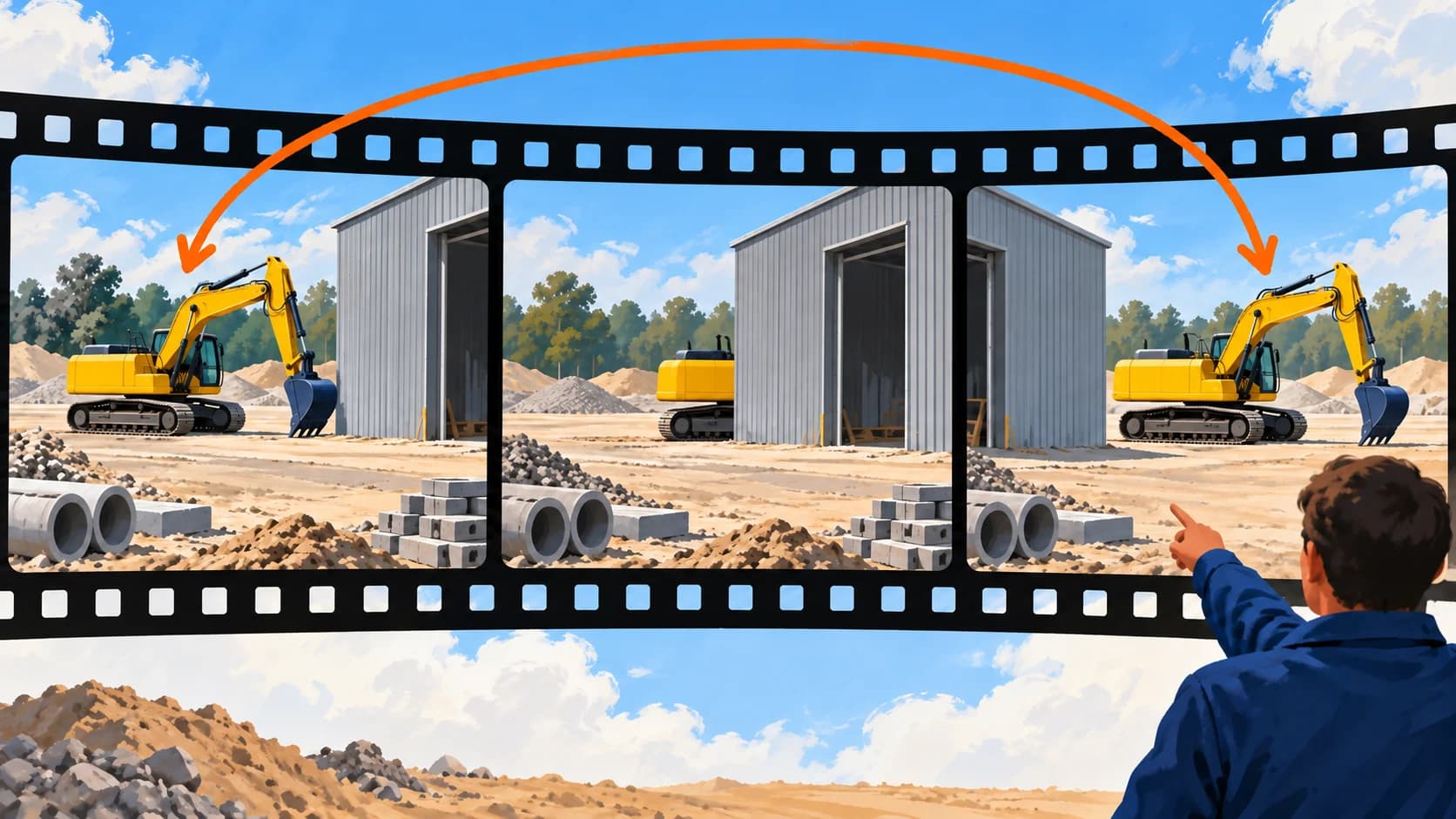
Glimpse is Elorian’s visual reasoning model, introduced on October 16, 2026 as a research preview. It can return to an image and specific areas of video while solving a task. For business use, it is worth testing whether this kind of review helps it correctly connect events and objects. Source: Elorian announcement.
This article is for video analytics leaders, process owners, and engineers. We break down the announcement and propose acceptance criteria; we did not run our own tests of Glimpse. The framework below is an editorial proposal that still needs to be validated on real data.
Key points: define in advance what counts as one object, require verifiable segments, and account for human work when correcting the answer. These conditions will help you run an experiment with any video analysis model.
AIrassvet editorial team · Prepared on October 17, 2026.
Contents:
- What repeated viewing changes
- What evidence the announcement provides
- How to set up a vehicle counting test
- What to include in the acceptance log
- How to choose the deployment boundary
- Questions about Glimpse
- How AIrassvet helps prepare video analytics
- How to get started
What repeated viewing changes
Visual reasoning means solving a task using image details, spatial relationships, and changes over time. With Glimpse, the developer shows a visual scratch space: a working area with zooming and repeated viewing of segments. Among the published breakdowns is a change from 8 fps to about 14 fps over a 0.9-second interval. This is a specific demonstration, not a mandatory processing mode for every file. Description of the mechanism.
To frame the task, it is useful to separate three questions: what is visible, whether the object’s identity is preserved, and what event has completed. For example, a car appearing after the camera turns does not by itself determine whether another car arrived. And bucket movement alone does not answer whether loading has finished.
Repeated viewing should be evaluated by the errors it corrects. If the system returns to the video but keeps the object linked incorrectly, the extra viewing did not help that answer. We suggest checking the final decision together with the segments it relies on. The overall architecture of this kind of process is covered in the article on agentic video analysis.
What evidence the announcement provides
Elorian publishes its own evaluation table and examples. It is important to distinguish a model’s recorded answer from an illustration with verified ground truth: both types appear in the announcement. The developer also classifies direct action output for robot control as future work. These boundaries are stated in the initial announcement.
Additional context comes from Elorian’s separate material on Humanity’s Sixth Sense, or HSS. The benchmark was created together with Scale AI and includes 522 tasks: 288 images and 234 videos. Answers are open-ended; evaluation uses human-written rubrics. The authors emphasize that results depend on model versions and the reasoning mode. HSS description.
For a customer, the editorial recommendation is this: ask for the ground truth, the scoring rules, and the actual result of the selected system separately. A polished demo video may explain the idea, but acceptance criteria require a clear link between input and output. Even a well-presented individual example leaves open the question of error frequency on your own dataset.
This article does not provide independent confirmation of Glimpse’s quality. We did not test the API, speed, Russian-language prompts, or stability on long recordings. That is why we recommend tying the deployment decision to your own controlled comparison.
How to set up a vehicle counting test
Let’s look at a hypothetical construction yard. A yellow excavator passes behind a temporary structure and appears on the other side. The manager needs a list of unique machines per shift. The operator may describe two appearances even though it was the same machine. This is a training scenario, not a Glimpse result or a customer case.
Start by defining the unit of measurement. Write down whether you need a count of unique machines for the entire file, the number of line crossings, or the number of objects visible in the frame at the same time. These tasks have different ground truths. As long as the definition allows multiple interpretations, comparing answers will test the wording more than the model’s quality.
Next, prepare examples with an object returning, partial occlusion, a similar second machine, and camera movement. It is best to create the labeling before reviewing the system’s answers. If a person also cannot determine identity from the image, that episode should be marked separately as uncertain.
Recommended answer format:
- the identifier of the presumed machine and visible features;
- its appearance intervals with timestamps;
- the basis for linking the appearances together;
- the disputed segment and what remains unknown.
This type of prompt does not guarantee a reliable explanation. The reviewer should open the specified intervals and compare the answer with the frames. For organizing the cameras, observation zones, and review process itself, the article on video analytics for warehouses is useful.
What to include in the acceptance log
Below is a proposed log structure. This is an editorial template for a future check; we did not measure its effectiveness. Fill it out using actual answers, while keeping the source videos and selected configuration.
| Field | What to record | Why it matters |
|---|---|---|
| Unit of measurement | Unique machine, appearance, or line crossing | Eliminate different interpretations of the question |
| Ground truth | Annotator’s answer and disputed intervals | Evaluate the model using a predefined rule |
| Object linkage | Which appearances are grouped together and why | Detect repeated counting or incorrect merging |
| Event confirmation | Timestamps and observable features | Open exactly the moment that resolves the task |
| Correction | Error, human decision, review duration | Account for manual work after the answer |
| Configuration | Model version, prompt, mode, file parameters | Preserve the comparison conditions |
Compare systems on the same set of files and using one rubric. If you change the prompt, save the previous version; otherwise it will be difficult to tie any improvement to a specific cause. Count errors involving unique objects and errors involving events separately so that a correct count does not hide an incorrect action sequence.
Negative examples are especially useful: a similar machine that did not drive out from behind the structure; motion without completion of the operation; an episode where the needed object is fully blocked. The expected answer may include uncertainty. For some processes, that is preferable to an unverified claim, but the acceptability of such an answer should be agreed in advance.
How to choose the deployment boundary
On the Elorian models page the company offers enterprise customers evaluation on their own data and deployment discussions. The support page lists the API and an interactive chat. These are the vendor’s own statements; we did not verify access from Russia, contractual terms, or the suitability of any specific hosting setup.
For an initial comparison, choose a task where the answer can be verified before any action is taken. For example, preparing a draft list of segments for an employee. Decide in advance who accepts the result and what happens if an event is missed. If an error immediately triggers a physical action, the process verification requirements will be significantly broader than the log described here.
We recommend evaluating costs for the actual task. Save the real API usage, wait time, and manual review time. The token price by itself does not answer how much a correct final annotation costs. Savings can only be discussed after comparing them with the current process under agreed conditions.
Separately define the rules for transferring video: which materials are allowed, which must be anonymized, who has access, and when the source files are deleted. This is a list of questions for the data owner and the vendor, not a statement about Glimpse settings. If there is no answer, that condition remains unresolved.
Questions about Glimpse
Should you replace your current video analytics system as soon as it is announced?
First define the task and compare the systems on your own data. The proposed log will help separate counting, identity, and event errors; the announcement alone does not determine whether a replacement fits your process.
Do the selected examples prove quality across the entire archive?
A selected example does not let you determine the error rate for the full collection. That requires a separate dataset with a prebuilt ground truth, including difficult and ambiguous cases, and consistent evaluation rules.
What should you ask for along with the final object count?
Ask for appearance intervals, identity markers, disputed points, and segments for review. Then open those segments: a detailed explanation can also be wrong. Agree on when the system should recognize that the data is insufficient.
How can you tell whether implementation is economically justified?
Compare the full process with your current workflow: service usage, wait time, corrections, and result acceptance. Until you do that comparison, savings and the cost of accepted annotation remain unknown.
How AIrassvet helps prepare video analytics
For this kind of task, AIrassvet is relevant for data preparation, computer vision, and integration testing. The work can be tied to specific actions: define the accounting unit, prepare the labeling and evaluation criteria, and connect the accepted result to a business system. This is not a promise of Glimpse support or a specific accuracy level; the studio's capabilities are described on the official page.
The first step is to choose one process, its current outcome, video sources, constraints, and acceptance criteria. Discuss the task.
Where to start
Glimpse gives you a reason to check where repeated access to video helps solve your task. Start by defining the object and event, prepare a ground truth, and save disputed episodes. Then evaluate the accepted responses together with manual corrections. That way, the implementation decision will be based on the observed performance of the selected system in your process.