Meeting recordings can be transcribed entirely on your own computer or server using open models GigaAM, Whisper, and Parakeet, with no upload to the cloud. There is no universal winner. In a benchmark published on Habr on October 17, 2026, GigaAM-v3 came out best on ordinary Russian speech (14.8% word error rate), while Whisper large-v2 and Parakeet were more accurate on speech with IT terminology (39–40%). The cascade "GigaAM + term corrections from Parakeet" reduced the overall error rate from 27.0% to 21.7%. For your own company, you should choose a model based on a benchmark using your own recordings.
Prepared by AIrassvet October 18, 2026 based on a Habr post by the author of the Recorder app, Pavel (@pahaz), the model pages for GigaAM, Whisper, and Parakeet, and the text of Federal Law 152-FZ. It is intended for executives, board secretaries, in-house counsel, and IT teams that want meeting transcripts without sending conversations to external services. We did not run our own benchmarks: all accuracy figures are taken from the publication author’s own recordings, and the verification steps and test-set template are the editorial team’s methodology. AIrassvet is not affiliated with the author, Sber, OpenAI, or NVIDIA; the section at the end of the article describes the publisher’s services.
Contents
- At a glance
- What local transcription is
- Why transcribe meetings without the cloud
- Which open models are available for Russian speech
- How the benchmark was conducted
- Results: which model is more accurate
- Why WER alone is not enough
- A two-model cascade
- What did not work
- How to choose a model for your company: 6 steps
- Test-set template
- When to choose each model
- Frequently asked questions
- Primary sources and verification method
At a glance
- No cloud required. GigaAM, Whisper, and Parakeet are released with open weights and run on a regular computer, including without a graphics card.
- For standard speech, choose GigaAM. On meeting clips, GigaAM-v3 had a 14.8% word error rate versus 24.6% for Parakeet and 27–30% for Whisper.
- For terminology, choose Whisper large-v2 and Parakeet. On IT-focused speech, they had 39–40% errors versus 52.9% for GigaAM.
- A two-model cascade. GigaAM provides the base text, and Parakeet fills in the terminology. The overall error rate was 21.7% versus 27.0% for GigaAM alone; the share of correctly transcribed terms rose from 19% to 44%.
- Speed. On an Intel Core i9 processor without a graphics card, the cascade transcribes one hour of audio in about 18 minutes.
- Main recommendation. Choose a model based on a benchmark using 30–60 minutes of your own recordings, not someone else’s table.
What local transcription is
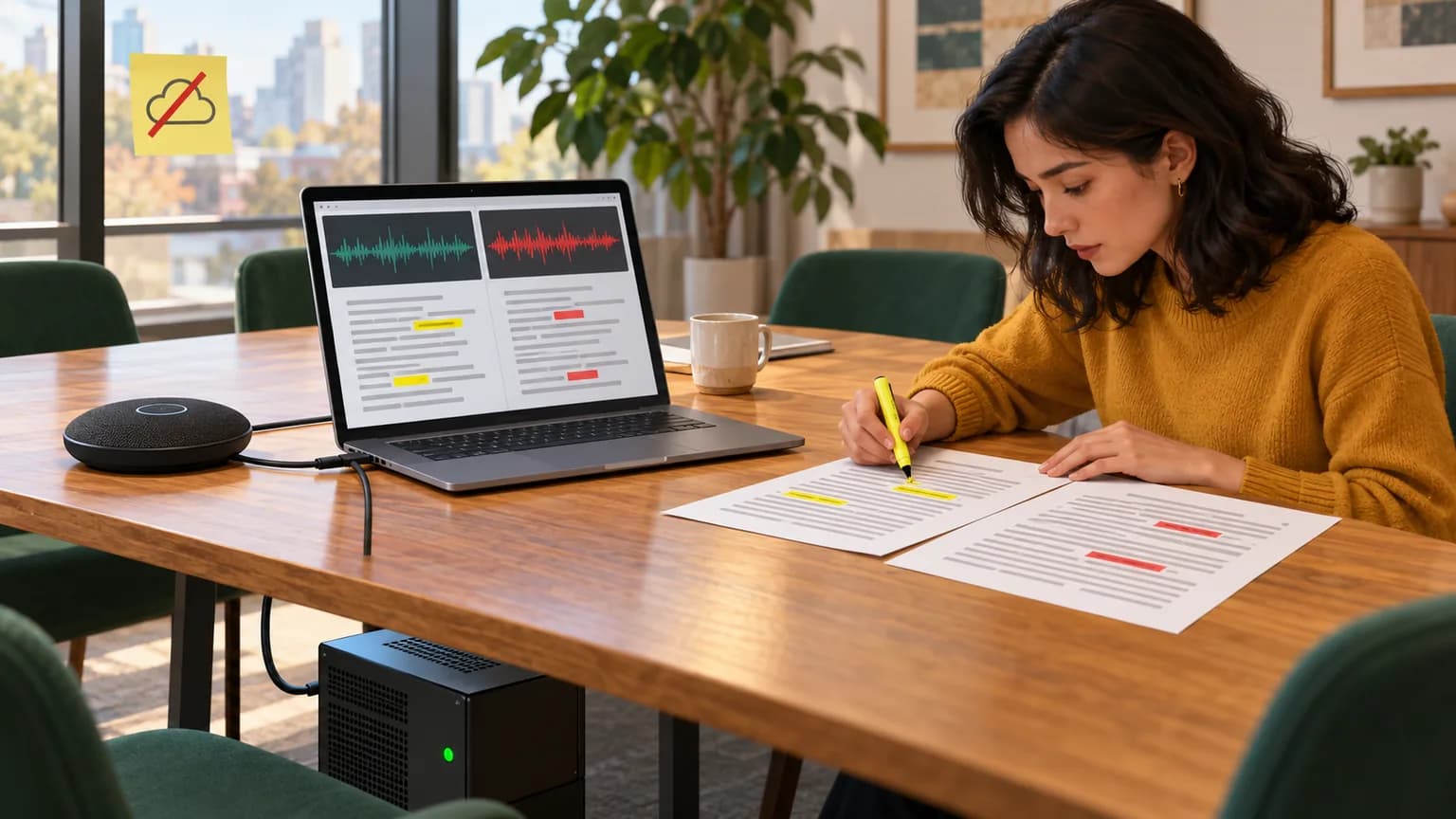
Local transcription is converting a conversation recording into text using a speech-recognition model that runs on your computer or server. The audio and text do not leave the device, unlike cloud services, where the recording is uploaded for processing.
WER (Word Error Rate, word error rate) is the main accuracy metric for speech recognition. It counts substitutions, deletions, and insertions relative to the reference text. The lower the WER, the better: 15% means roughly one error in seven words.
Transcription is only the first step. The transcript is then turned into minutes, a list of action items, and tasks. We described how to set up that process through tasks in Bitrix24 in the article "AI for meeting minutes and tasks in Bitrix24". Here, we focus on choosing the recognition model that determines the quality of everything else.
Why transcribe meetings without the cloud
The author of the benchmark put the reason simply: his meetings discuss budgets, staffing decisions, contract terms, and internal company issues, and not every such meeting can be sent to an external service. For a company, there are three reasons:
- trade secrets — the substance of negotiations, prices, and deal terms;
- personal data — names, titles, discussions about employees and clients. If the transcription service is located abroad, transferring such data falls under cross-border transfer rules — Article 12 of Federal Law 152-FZ;
- control over storage — the recording and transcript stay wherever the company stores them, and are deleted according to its rules.
This is not legal advice: which recordings may be processed and where should be confirmed with legal counsel and your security team. A local model removes the issue of sending audio to a third party, but it does not eliminate the need for participant consent to record or the rules for data retention.
Which open models are available for Russian speech
| Model | Developer | License | What matters |
|---|---|---|---|
| GigaAM-v3 | Sber (salute-developers) | MIT | trained on Russian speech: 700,000 hours of pretraining and 4,000 hours of labeled audio; an end-to-end version with punctuation is available |
| Whisper large-v2, large-v3, turbo | OpenAI | MIT | a multilingual model, widely known, with many ready-made applications |
| Parakeet TDT 0.6B v3 | NVIDIA | CC-BY-4.0 | a multilingual model for 25 European languages, including Russian; fast |
| Qwen3-ASR 1.7B | Alibaba Qwen | — | included in the benchmark as an additional model |
Licensing and training data are based on the GigaAM repository, Whisper repository and Parakeet model card on Hugging Face as of October 18, 2026. We did not verify the Qwen3-ASR license.
The GigaAM developers report that GigaAM-v3-e2e beats Whisper large-v3 in pairwise comparisons 70% of the time versus 30%. That is the developer’s claim; the independent measurement below shows a more nuanced picture.
How the test was conducted
Author collected four labeled datasets — about 1 hour 38 minutes of audio and 8.7 thousand words with reference text:
| Dataset | What was recorded | Duration | Words / share of terms |
|---|---|---|---|
| Business meetings | 82 challenging excerpts from work meetings + 82 random excerpts | about 24 minutes | 1870 / about 5% |
| IT speech | specially prepared text with a high density of IT terms | about 24 minutes | 1679 / about 41% |
| “Feed Trough” | a story read by two voices | about 24 minutes | 2391 / about 14% |
| Synthetic | 200 phrases voiced by a text-to-speech system | about 26 minutes | 2831 / about 14% |
The author ultimately excluded the synthetic set: its results differed noticeably from live speech. He also checked the conclusions against an archive of 185 recordings with a total duration of 36 hours (about 230 thousand words) — without full annotation.
Test conditions:
- before comparison, the text was converted to lowercase, "yo" was replaced with "e," and punctuation was removed — WER did not evaluate punctuation;
- audio was fed in chunks of up to 20 seconds, split at pauses;
- the tests were run on an Intel Core i9 CPU without GPU acceleration;
- in total, 32 configurations were compared: different models, quantization settings, prompts, and runtime methods.
Results: which model is more accurate
WER according to the author’s data, lower is better. Whisper was run with the Russian language explicitly specified and without a text prompt.
| Model | Meetings | IT speech | “Feed Trough” | Total |
|---|---|---|---|---|
| GigaAM-v3 e2e | 14.8% | 52.9% | 16.3% | 27.0% |
| Parakeet TDT 0.6B v3 | 24.6% | 40.0% | 13.9% | 24.6% |
| Whisper large-v2 | 30.1% | 39.0% | 11.5% | 24.8% |
| Whisper large-v3 | 27.1% | 59.8% | 11.6% | 30.3% |
| Whisper large-v3-turbo | 28.7% | 66.5% | 11.1% | 32.5% |
| Qwen3-ASR 1.7B | 30.1% | 48.6% | 14.7% | 29.0% |
What follows from this:
- On ordinary conversation, GigaAM leads — with almost twice as few errors as Whisper. That is expected: the model was trained on Russian speech.
- On IT terminology, GigaAM loses — it renders English-language names in Cyrillic or distorts them.
- The new Whisper is not always better than the old one. Large-v2 is more accurate than large-v3 on terminology. The author suggests a reason: most of the training data for v3 was labeled by v2 itself, and mixed Russian-English speech did not improve as a result.
- Quantization has little impact. Parakeet on meetings: 24.6% exact accuracy, 25.5% in Q8, and 25.7% in Q6_K. For GigaAM, the Q8 and F32 results were nearly identical.
- Fine-tuned Russian versions of Whisper on the author's data performed worse than the original models.
Why WER Alone Is Not Enough
WER does not know which word matters. Replacing a system name and dropping the word "nu" count as one error each, even though without the name the meaning of the conversation is lost. And conversely, "elastic" instead of Elastic is an error for the metric, but a reader who knows the product will understand the meaning.
To separate spelling mistakes from real distortions, the author introduced a custom heuristic — phonetic WER (WERx): Latin text is converted into a Cyrillic phonetic key, and a word that sounds similar is not counted as an error. The result on IT speech:
| Model | WER | WERx | Accurately written terms |
|---|---|---|---|
| GigaAM | 52.9% | 40.6% | 19% |
| Parakeet | 40.0% | 30.7% | 47% |
| Whisper large-v2 | 39.0% | 30.3% | 54% |
Even when sound is taken into account, GigaAM still trails Parakeet by almost 10 percentage points on terms. The gap is smaller on meetings: GigaAM goes from 14.8% to 14.1%, while Parakeet goes from 24.6% to 23.6%. Business takeaway: in addition to overall WER, track the share of correctly transcribed important words — system names, product names, customer names, and numbers.
A Two-Model Cascade
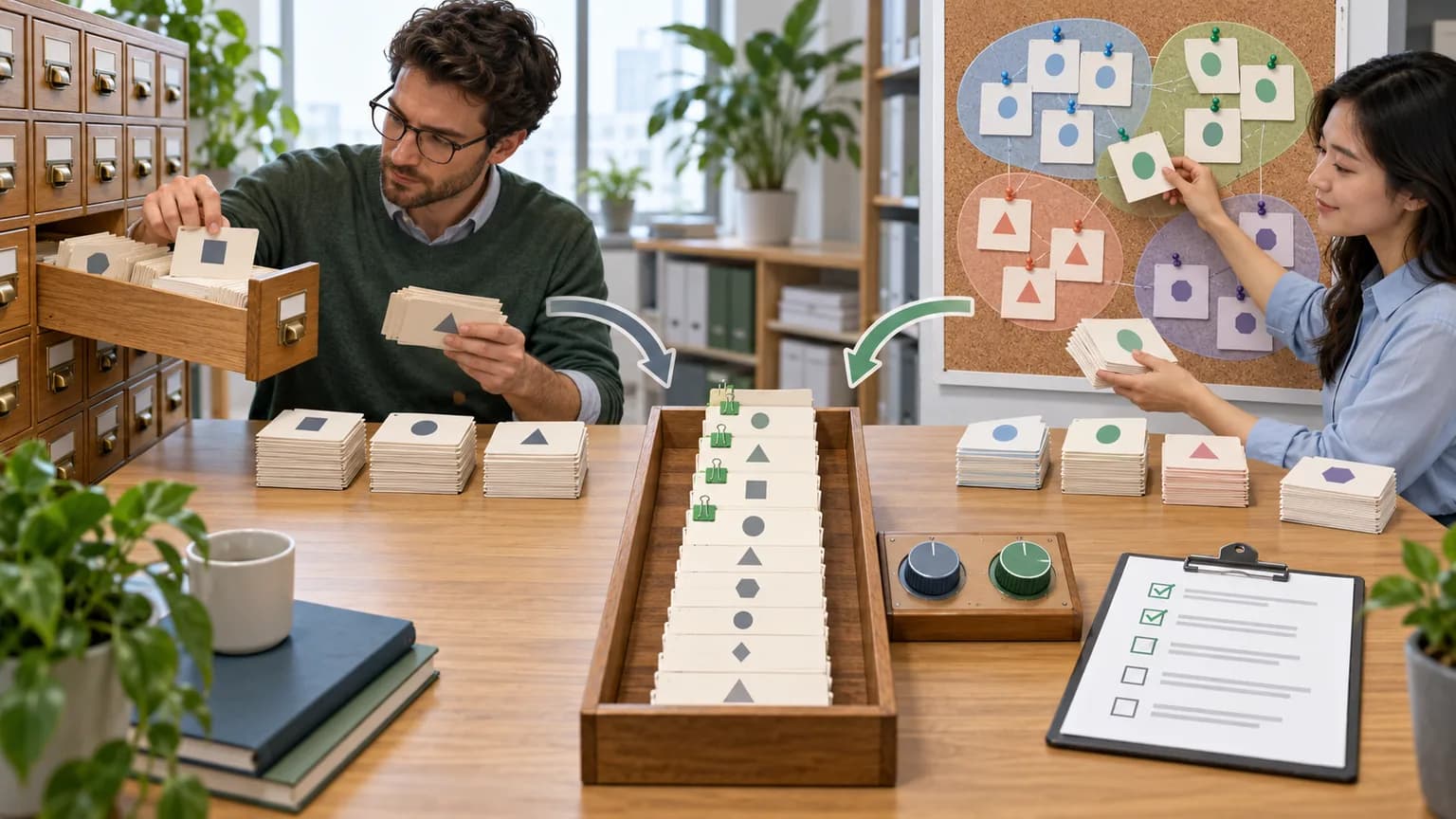
The author combined the strengths of two models. GigaAM provides the base transcript, while Parakeet independently recognizes the same audio. The texts are then aligned, and where they differ, the Parakeet version is chosen — but only if it contains Latin characters and is phonetically similar enough to the GigaAM version.
That is how "apkid" became AppKit, and "Promius" became Prometheus. But there were also mistakes: "klot" became Cloud instead of Claude. The main parameter is the similarity threshold. At a threshold of 0.4:
| Variant | Meetings | IT speech | "Feeder" | Total |
|---|---|---|---|---|
| GigaAM | 14.8% | 52.9% | 16.3% | 27.0% |
| Parakeet | 24.6% | 40.0% | 13.9% | 24.6% |
| GigaAM + Parakeet corrections | 14.5% | 41.9% | 12.0% | 21.7% |
What matters:
- without requiring Latin characters, the cascade made meeting results worse — up to 17.4% errors, because it also pulled in Parakeet's mistakes on ordinary words;
- on dense IT speech, Parakeet alone outperformed the cascade — 40.0% versus 41.9%;
- the cost of the cascade is a second pass. The real-time factor is about 0.3: roughly 18 minutes per hour of audio on an Intel Core i9 processor;
- the reverse setup did not work. The Parakeet transcript corrected by GigaAM did not beat GigaAM alone.
The author also compared which model better corrects GigaAM. Whisper medium delivered a slightly lower overall WER (21.4%) than Parakeet (22.0%), but it ran about three times slower: a real-time factor of 0.45–0.68 versus 0.15–0.23. Choosing Parakeet is a trade-off between accuracy and speed.
What Didn't Work
Negative results from the same publication are just as useful: they save weeks of experimentation.
- Replacement dictionary. A dictionary built from short IT recordings improved results on those same recordings by 6–13 points, but on a new long recording it improved by only 0.3–0.5 points. A large dictionary with 8,130 terms on the archive turned "nas" into NAS 1,246 times, and "net" into .NET 864 times. A frequency filter helped: the number of false triggers dropped from 3,175 to 449.
- Audio chunk overlap. A two-second overlap reduced WER on short segments by 0.4 points, but on full recordings WER rose from 30.8% to 31.3%.
- Prompting Whisper. A prompt with terms reduced Whisper large-v3 WER on the IT test set from 59.8% to 58.1%, but on meetings it increased from 27.1% to 66.7%.
- A smarter replacement-selection metric. Its own accuracy improved, but the cascade WER did not.
The main lesson: test any improvement on the recordings it was not designed for. What helps on one type of speech can break another.
How to Choose a Model for Your Company: 6 Steps
The order below is the editorial team's method based on the measurements.
- Collect 30–60 minutes of your own recordings. Use a mix of routine meetings, client calls, and technical discussions in the same proportions you typically see. Include the difficult parts too: background noise, interruptions, and jargon.
- Create a reference transcript. A person manually transcribes the selected excerpts. This is the most time-consuming part — the author of the benchmark also calls annotation the biggest time expense.
- Make a list of key terms. Product names, systems, clients, surnames, numbers. You’ll use these to calculate the share of terms transcribed correctly.
- Run 2–3 models. At minimum, test GigaAM and one multilingual model — Parakeet or Whisper. Calculate WER separately by recording type and the share of key terms.
- Measure speed on your own hardware. How many minutes it takes to process one hour of audio on the server or laptop where the model will run.
- Test on a long recording. Check any setting — dictionary, prompt, cascade — on a full recording that was not in the test set.
After you choose a model, the process still remains: who submits the recording, where the files are stored, how the transcript becomes meeting minutes. If you analyze calls rather than meetings, see the article “Speech Analytics for Calls with AI”.
Test Set Template
The template was prepared by the editorial team. One row equals one segment.
Segment: VST-07
Type: weekly sales team meeting
Duration: 3 min 20 sec
Conditions: conference room, conference microphone, 5 participants, interruptions
Reference: file VST-07_reference.txt (transcribed by: secretary, verified by: manager)
Key terms: “Bitrix24”, “Ozon”, “quote”, “Ivanov”, “November 12”, “340 thousand”
What we measure:
  - WER for the segment
  - share of key terms transcribed correctly
  - recognition time on the target server
Results:
  GigaAM-v3 e2e: WER __%, key terms __ of 6, time __ s
  Parakeet TDT 0.6B v3: WER __%, key terms __ of 6, time __ s
  Whisper large-v2: WER __%, key terms __ of 6, time __ s
When to Choose Each Model
Table — editorial methodology based on the published benchmark; results for your own recordings may differ.
| Your Meetings | Where to Start | Why |
|---|---|---|
| Everyday business speech in Russian, with few technical terms | GigaAM-v3 | fewest errors in meeting tests |
| Many English names and IT terms | Parakeet or Whisper large-v2 | handle terms better |
| Mixed meetings: Russian speech and technical terms | GigaAM + Parakeet cascade | best overall WER in the benchmark |
| You need maximum speed on modest hardware | Parakeet | several times faster than Whisper |
| Fully English-language meetings | multilingual model, test separately | the benchmark was done on Russian speech |
When these recommendations don’t fit: if your recordings are phone calls, factory-floor audio, or speech with strong accents, the conditions differ greatly from the benchmark — start with your own test set.
Frequently Asked Questions
Can you transcribe meetings without the cloud?
Yes. Open-source models GigaAM, Whisper, and Parakeet run on your own computer or server, including without a GPU. The audio and text never leave the device.
Which model recognizes Russian speech best?
In the October 17, 2026 benchmark on Habr, GigaAM-v3 was the most accurate on ordinary meetings — 14.8% word errors. On speech with IT terms, Whisper large-v2 and Parakeet performed better — 39–40%.
What is WER in speech recognition?
WER (Word Error Rate) is the share of word-level errors: substitutions, deletions, and extra words compared with the reference text. The lower the number, the more accurate the model. This metric usually does not count punctuation.
How long does local transcription take for one hour of audio?
In the benchmark, the GigaAM and Parakeet cascade on an Intel Core i9 processor without a GPU transcribed one hour of audio in about 18 minutes. You should measure the time separately on your own hardware.
Do you need a GPU for local transcription?
Not necessarily. The benchmark in the publication was done on a CPU without GPU acceleration. A GPU will speed up processing, which matters when you have a large volume of recordings.
Does local transcription solve personal data issues?
Partially. It eliminates sending audio to a third party, but it does not replace participant consent for recording or storage rules. The handling process for recordings should be agreed with legal counsel.
Primary Sources and Verification Method
Method: On October 18, 2026, we read the benchmark publication in full, extracted the datasets, conditions, tables, and negative results, and cross-checked the figures between the tables and the author’s text. We verified licenses and model training information on the developers’ pages. AIrassvet did not conduct its own benchmark; the six steps, test set template, and selection table are the editorial team’s methodology.
- Habr, 10/17/2026, Pavel (@pahaz): “Free audio-to-text transcription without the cloud: why one model wasn’t enough for me” — datasets, WER tables, the cascade, and negative results.
- GitHub: salute-developers/GigaAM — MIT license, model versions, training volume, and a comparison claim versus Whisper.
- GitHub: openai/whisper — MIT license.
- Hugging Face: nvidia/parakeet-tdt-0.6b-v3 — CC-BY-4.0 license, supported languages.
- ConsultantPlus: Federal Law No. 152-FZ “On Personal Data” — Article 12 on cross-border transfers.
Limitations: the benchmark was conducted by one person on their own recordings; the meeting set intentionally included difficult segments; the total length of annotated audio was about 1.5 hours. The author is the developer of the “Recorder” app, which uses the cascade described. You cannot apply these numbers to your company’s recordings without your own testing.
How AIrassvet Helps with Meeting Transcription and Minutes
A local speech recognition model solves only part of the problem: next, it has to fit into the workflow — from recording to meeting minutes and action items. On the AIrassvet website the areas directly related to this task are described:
- deploying LLMs on the client’s servers to prepare meeting minutes from transcripts when recordings and text must stay within the company’s environment;
- multimodal AI integrations, where voice, text, and documents are processed in a single working environment;
- AI agents that turn transcripts into meeting minutes and send action items to CRM or task management systems;
- process audits, building a test set of recordings, testing, and deployment.
The first step is to choose one type of meeting, describe how the minutes are prepared today and how much time that takes, what restrictions there are on storing recordings, and the acceptance criterion, for example the share of key words captured accurately on a test set.
Bottom line: choose the model based on your own recordings
Local meeting transcription already works on standard hardware, and there are strong open-source models for Russian speech. But the Habr benchmark showed the key point: every model has its own weaknesses. GigaAM handles everyday conversation better, Parakeet and Whisper large-v2 are better with terminology, and a two-model cascade delivers the best overall result at the cost of a second pass.
So don’t choose a model based on someone else’s table. Collect 30 minutes to an hour of your own recordings with a ground truth transcript, count the errors and the share of important words, measure the speed on your own server — and only then build the transcription and minutes workflow.