Osterwalder’s Business Model: A Complete Guide for Entrepreneurs
Introduction
In today’s fast-paced business world, a company’s success depends largely on a clear understanding of its business model. That’s where Alexander Osterwalder’s Business Model Canvas comes in, also known as the Business Model Canvas. This strategic management tool has truly revolutionized the way business models are designed, analyzed, and transformed. Developed by Swiss business theorist Alexander Osterwalder in collaboration with Yves Pigneur, this tool makes it possible to visualize the key elements of a business on a single page, turning complexity into something simple and easy to understand.
The History of the Business Model Canvas
Alexander Osterwalder began working on the business model concept back in the early 2000s while writing his doctoral dissertation at the University of Lausanne. His goal was to create a universal language for describing and discussing business models. In 2010, the book Business Model Generation was published and quickly became a bestseller, later translated into dozens of languages. Today, millions of entrepreneurs, startups, and major corporations around the world use this tool.
Osterwalder’s canvas replaced bulky business plans that ran hundreds of pages with a simple visual format that fits on one sheet. This is not just simplification for its own sake, but a fundamentally new approach to strategic thinking that emphasizes key elements and how they connect.
The Philosophy and Principles of the Canvas
The Business Model Canvas is built on several core principles. First is simplicity and visualization. The human brain processes visual information better, and being able to see the entire business model on one page makes understanding and communication much easier. Second is focus on the key elements. The canvas forces you to concentrate on what matters most while filtering out the rest. Third is flexibility and adaptability. The canvas is easy to change, test against different hypotheses, and experiment with different business model options.
It is important to understand that Osterwalder’s canvas is not just a template to fill in, but a strategic thinking tool. It helps you ask the right questions, identify weak spots in a business model, find new opportunities for growth, and drive innovation.
The Nine Key Building Blocks of the Business Model
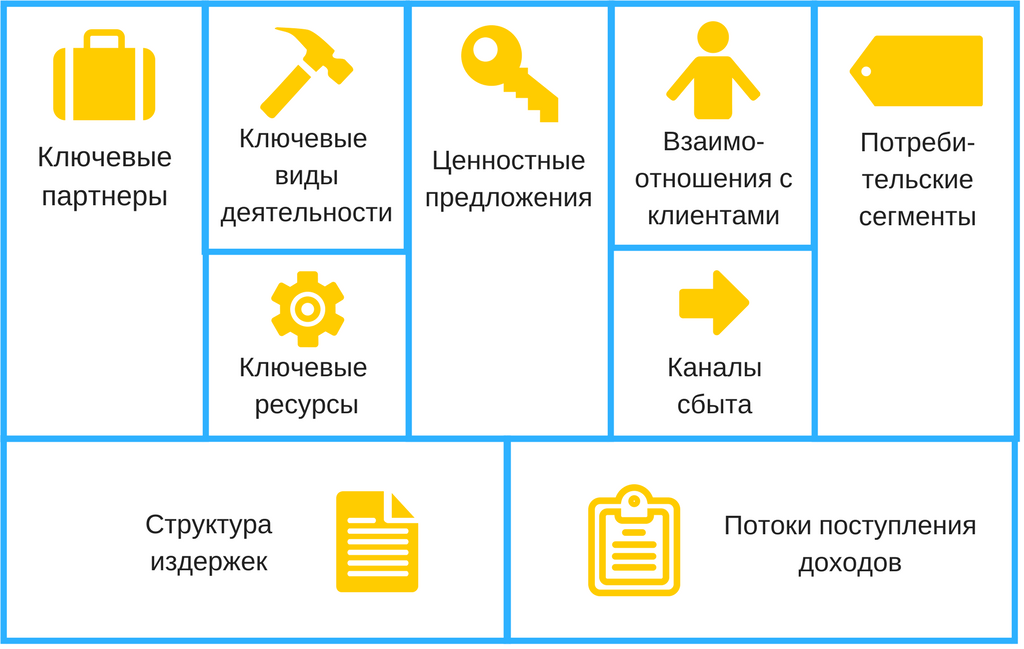
Let’s take a closer look at each of the nine building blocks shown in your diagram.
1. Customer Segments
This is the cornerstone of any business model. Customer segments define the different groups of people or organizations your company aims to reach and serve. No company can exist without customers, so understanding who you are creating value for is critically important.
There are several types of customer segments. A mass market means the company does not distinguish between customer segments and offers the same value proposition to all potential customers. A niche market targets specialized, narrow customer segments with specific needs. A segmented market distinguishes between customer segments with slightly different needs and problems. A diversified market serves two or more segments with completely different needs and problems. Multi-sided platforms serve two or more interdependent segments.
When defining customer segments, it is important to ask yourself the following questions: Who are we creating value for? Who are our most important customers? What are their demographic characteristics, behavioral traits, needs, and pain points? How can we segment our customers most effectively?
A deep understanding of customer segments makes it possible to create more precise value propositions, choose the right distribution channels, and build more effective customer relationships.
2. Value Propositions
A value proposition is what solves customer problems or satisfies their needs. It is the combination of products and services that creates value for a specific customer segment. In essence, it answers the question: why should a customer choose you?
Value can be created through different elements: novelty (meeting previously unmet needs), performance (improving product or service features), customization (adapting products and services to specific needs), design (superior design), brand and status (using and displaying a certain brand), price (offering similar value at a lower price), cost reduction (helping customers reduce costs), risk reduction (reducing the risks customers face), accessibility (providing access to products and services that were previously unavailable), and convenience and usability (making the customer’s life easier).
A strong value proposition is quantifiable, measurable, and specific. It clearly states what problem it solves and what benefit it delivers to the customer. It is important to remember that a value proposition should be written from the customer’s perspective, not the company’s. It is not a list of your product’s features, but a description of how your product improves the customer’s life.
Many successful companies have built their business on unique value propositions. For example, Uber offered convenience and accessibility in transportation services through a mobile app, revolutionizing the taxi industry. Airbnb created value by providing access to unique accommodations around the world at affordable prices.
3. Channels
Channels describe how a company communicates with its customer segments and delivers its value proposition to them. Customer communication channels, sales channels, and distribution channels make up the company’s interface with customers.
Channels serve several important functions: they raise customer awareness of the company’s products and services, help customers evaluate the company’s value proposition, allow customers to purchase specific products and services, deliver the value proposition to customers, and provide after-sales customer support.
Channels can be owned or partner-based, direct or indirect. Owned channels can be direct (for example, an in-house sales team or website) or indirect (for example, a company-owned retail network). Partner channels can be indirect (for example, wholesale distribution or partner retail) or direct (sales through partner websites).
Choosing the right channels is critical to business success. A company must find the right balance between owned and partner channels, taking into account factors such as cost, reach, efficiency, and control. It is also important to understand the customer journey and deliver a consistent experience at every stage of interaction.
In today’s digital world, many companies use an omnichannel approach, integrating online and offline channels to create a seamless customer experience. For example, a customer may research a product online, buy it in a physical store, and get support through a mobile app.
4. Customer Relationships
This block describes the types of relationships a company establishes with specific customer segments. Relationships can range from personal to fully automated. A company must clearly define the type of relationship it wants to establish with each customer segment.
There are several categories of customer relationships. Personal assistance involves interaction with a real company representative. This can happen at the point of sale, through call centers, by email, or through other channels. Dedicated personal assistance means that a specific account manager is assigned to a particular customer and handles their service. This is the deepest and most intimate type of relationship, usually developing over a long period of time.
Self-service does not involve direct relationships with customers; the company provides all the necessary tools so customers can help themselves. Automated services are a more advanced form of self-service with automated processes. For example, personalized online profiles give customers access to customized services.
Communities allow companies to interact more closely with customers and prospects, and also give community members a way to share knowledge and solve each other’s problems. Co-creation of value means companies go beyond traditional customer relationships and involve customers in creating value together. For example, Amazon invites customers to write reviews, creating value for other shoppers.
The choice of relationship type affects the customer experience and the economics of the business model. More personalized relationships are usually more expensive, but they can lead to higher loyalty and customer lifetime value.
5. Revenue Streams
Revenue streams are the money a company receives from each customer segment. If customers are the heart of the business model, revenue streams are its arteries. A company should ask itself: what value are customers really willing to pay for? What are they paying for now? How are they paying? How would they prefer to pay? How much does each revenue stream contribute to total revenue?
A business model can include two different types of revenue streams. Transaction revenues come from one-time customer payments. Recurring revenues come from ongoing payments for delivering the value proposition to customers or providing after-sales support.
There are several ways to generate revenue streams. Asset sales involve selling ownership rights to a physical product. This is the most common and straightforward way to generate revenue. Usage fees arise from the use of a specific service. The more the service is used, the more the customer pays. Subscription fees are generated by selling ongoing access to a service. For example, a fitness club sells its members monthly or annual subscriptions in exchange for access to its services.
Leasing, renting, and hiring are created by temporarily granting someone the exclusive right to use a specific asset for a fixed period of time in exchange for a fee. Licensing gives customers permission to use protected intellectual property in exchange for royalties. Brokerage fees come from intermediary services provided on behalf of two or more parties. Advertising comes from fees for advertising a specific product, service, or brand.
Each revenue stream can use different pricing mechanisms: fixed pricing, dynamic pricing based on market conditions, negotiation, yield management, auctions, and so on.
It is important to diversify revenue streams to reduce risk and ensure a more stable cash flow. Many successful companies use multiple sources of income. For example, newspapers earn money from subscriptions, advertising, and sponsorships.
6. Key Resources
Key resources describe the most important assets needed for a business model to function. Every business model requires key resources that allow the company to create and deliver the value proposition, reach markets, maintain relationships with customer segments, and generate revenue.
Key resources can be physical, financial, intellectual, or human. They may be owned by the company, leased, or acquired from key partners.
Physical resources include production facilities, buildings, vehicles, machinery, systems, point-of-sale locations, and distribution networks. For example, for a manufacturing company, a key resource would be production equipment; for a retail chain, it would be stores in the right locations.
Intellectual resources include brands, proprietary knowledge, patents and copyrights, partnerships, and customer databases. Intellectual resources are difficult to develop, but when successfully created, they can deliver significant value. For example, the Nike brand or a pharmaceutical company’s patents are critically important key resources.
Human resources are necessary for every business, but they are especially important in certain business models. For example, in creative and knowledge-intensive industries, human resources are critically important. A pharmaceutical company relies heavily on its research scientists, and a consulting firm depends on its consultants.
Financial resources include cash, lines of credit, or a pool of stock options for hiring key employees. Some business models require financial resources and financial guarantees, such as cash, lines of credit, or a pool of stock options.
When analyzing key resources, it is important to focus on the assets that are truly critical to creating and delivering the value proposition. Not every resource is a key resource—only those without which the business model cannot function.
7. Key Activities
Key activities describe the most important things a company must do for its business model to function. Every business model requires a set of key activities that are the most important actions the company needs to perform successfully.
Key activities can be divided into several categories. Production covers the design, manufacture, and delivery of a product in substantial quantities or at superior quality. Production activities dominate the business models of manufacturing firms.
Problem solving is a key activity category tied to developing new solutions for individual customer problems. The operations of consulting firms, hospitals, and other service organizations are typically dominated by problem-solving activities. Their business models require key activities such as knowledge management and continuous learning.
Platforms and networks are connected to business models built around a platform as a key resource. Networks, matchmaking platforms, software, and even brands can function as a platform. In these cases, key activities are related to platform management, service delivery, and platform promotion.
Efficiently executing a business model may also require other key activities, such as marketing and sales, supply chain management, partnership management, and research and development.
It is important to understand that key activities must directly contribute to the value proposition, customer relationships, or revenue generation. Companies often make the mistake of spreading resources across many secondary activities instead of focusing on the truly critical ones.
8. Key Partners
Key partners describe the network of suppliers and partners that support a business model. Companies form partnerships for many reasons, and partnerships become a cornerstone of many business models. Companies create alliances to optimize their business models, reduce risk, or acquire resources.
There are four distinct types of partnerships. Strategic alliances between noncompetitors allow companies to gain the benefits of collaboration without direct competition. Coopetition is a strategic partnership between competitors, where companies cooperate in some areas while remaining competitors in others.
Joint ventures for developing new businesses allow partners to combine resources and expertise to create something new that would be difficult or impossible to build alone. Buyer-supplier relationships to ensure reliable supply are the most basic, but no less important, type of partnership.
There are three main motivations for forming partnerships. Optimization and economies of scale mean that a partnership can reduce costs through outsourcing or shared infrastructure. Reducing risk and uncertainty is achieved through partnerships that help lower risk in a competitive environment marked by uncertainty. Access to specific resources and activities allows companies to focus on their core competencies while leaving the rest to partners.
When building a partner network, it is important to clearly understand the value each partner brings to the business model and to structure relationships around mutual benefit. Strong partnerships can become a significant competitive advantage.
9. Cost Structure
The cost structure describes all costs associated with operating a business model. This block covers the most important costs incurred while running a particular business model. Creating and delivering value, maintaining customer relationships, and generating revenue all require costs.
Costs can be relatively easy to calculate once the key resources, key activities, and key partners have been identified. However, some business models are more cost-driven than others. So-called budget airlines, for example, have built business models focused entirely on low costs.
Business models can be either cost-driven or value-driven. Cost-driven business models focus on minimizing costs wherever possible. This approach aims to create and maintain the most economical cost structure by using low-cost value propositions, maximum automation, and extensive outsourcing.
Value-driven business models are less concerned with the cost implications of a particular business model design and instead focus on creating value. Premium value propositions and a high degree of personalized service typically characterize value-driven business models.
Cost structures can have the following characteristics. Fixed costs remain unchanged regardless of the volume of goods produced or services delivered. Examples include salaries, rent, and manufacturing facilities. Variable costs vary in proportion to the volume of goods produced or services delivered.
Economies of scale arise when costs benefit as the business expands. For example, large companies benefit from lower unit prices when purchasing in larger volumes. Economies of scope arise when costs benefit from a broader range of operations. For example, in a large company, the same marketing activities or distribution channels can support multiple products.
Interconnections Between the Blocks
One of the main strengths of the Business Model Canvas is that it shows not just separate business elements, but also the relationships between them. Each block affects the others, and a change in one block can have a ripple effect across the entire business model.
For example, if you decide to serve a new customer segment, you may need to adapt the value proposition, find new distribution channels, and build a different type of customer relationship, which in turn may require new key resources and activities, affecting the cost structure.
The right side of the canvas (customer segments, value propositions, channels, customer relationships, and revenue streams) focuses on customer value and revenue generation. The left side (key resources, key activities, key partners, and cost structure) focuses on efficiency and costs. A successful business model must balance both sides effectively.
Practical Uses of the Canvas
The Business Model Canvas can be used in many ways. For startups, it is a tool for designing an initial business model. Instead of writing a long business plan, founders can quickly sketch their ideas on the canvas, test assumptions, and iteratively improve the model.
For existing companies, the canvas serves as a tool for analyzing the current business model. Visualizing all the elements on a single page helps identify weak points, inefficiencies, and opportunities for improvement. The canvas can also be used to compare against competitors, understand their business models, and find differentiation.
The canvas is great for brainstorming and innovation. Teams can use it to generate and test new business models and experiment with different scenarios. The method is especially effective in group settings, when the team gathers around a large poster with the canvas and discusses each element.
For stakeholder communication, the canvas provides a shared language and a visual format that is easy for investors, partners, and employees to understand. This makes it easier to discuss strategy and build shared understanding.
The Canvas Workflow
Start by defining customer segments. Who are your customers? It’s important to be as specific as possible. Then formulate a value proposition for each segment. What problems are you solving? What benefits are you delivering?
After that, think about distribution channels. How will you deliver value to customers? Which channels are most effective for each segment? Define the type of relationship you want to build with each segment.
Then move on to revenue streams. What are customers willing to pay for? How much? How? This is a critically important element that determines the viability of the business model.
After working through the right side of the canvas, move to the left side. Identify the key resources needed to implement your business model. What do you need to create and deliver the value proposition? Then define the key activities. What must you do to make the business model work?
Think about key partners. Who can help you implement the business model? What activities or resources can you obtain from partners?
Finally, assess the cost structure. What costs arise in your business model? Which resources and activities are the most expensive?
It’s important to remember that the canvas is a living document. It should be continually reviewed and updated as the business develops, market feedback is received, and conditions change.
Business Model Validation
After filling out the canvas, it is critically important to validate your hypotheses. The canvas helps structure assumptions, but those assumptions need to be tested in practice. Steve Blank and Eric Ries developed the Lean Startup methodology, which complements the Business Model Canvas perfectly.
The core idea is to test hypotheses quickly, get feedback from real customers, and iteratively improve the business model. Instead of spending months or years developing the perfect product, companies create a minimum viable product and test it in the market.
For each section of the canvas, you can formulate hypotheses and define metrics that will show whether those hypotheses are correct. For example, a customer segment hypothesis might sound like this: "Young professionals ages 25-35 in major cities experience problem X and are willing to pay Y for a solution." You can test this hypothesis through interviews with potential customers, surveys, and ad campaign testing.
Common Mistakes When Working with the Canvas
Many entrepreneurs make common mistakes when using the Business Model Canvas. The first mistake is treating the canvas as a static document. The canvas should constantly evolve. The second mistake is filling it out alone. The canvas is most effective as a tool for collective thinking.
The third mistake is being too abstract. The wording should be specific and measurable. Instead of "provide quality service," it is better to write "ensure customer inquiry response time of less than 2 hours." The fourth mistake is not testing assumptions. The canvas is a set of hypotheses that must be validated.
The fifth mistake is ignoring the relationships between sections. Changes in one section should be aligned with the others. The sixth mistake is copying competitors’ business models without adaptation. What works for one company may not work for another.
The Evolution and Innovation of Business Models
The Business Model Canvas not only helps describe an existing business model, but also serves as a tool for innovation. There are several business model innovation patterns that can be applied.
Unbundling means separating a vertically integrated business into individual components. The Long Tail focuses on offering a large number of niche products, each of which sells relatively infrequently. Multi-sided platforms connect two or more separate but interdependent customer groups.
FREE as a business model means that a significant share of customers receives the product for free, while a small group of paying customers subsidizes the rest. Open business models involve systematic collaboration with external partners to create and capture value.
By applying these and other patterns to their canvas, entrepreneurs can generate innovative business models that create new sources of competitive advantage.
Digital Transformation and the Canvas
In the era of digital transformation, the Business Model Canvas is becoming even more relevant. Digital technologies open up new opportunities for innovation across all sections of the canvas. For example, artificial intelligence and big data make it possible to better understand customer segments and create more personalized value propositions.
Digital channels and platforms are radically changing how companies interact with customers and deliver value. Cloud technologies make it possible to reduce the cost of key resources. Ecosystem models require new types of partnerships.
Many traditional companies use the canvas to plan their digital transformation, creating a new digital business model alongside the existing one.
Conclusion
Alexander Osterwalder’s Business Model Canvas is a powerful strategic management tool that revolutionized the way business models are designed, analyzed, and innovated. Its simplicity and visual format make complex ideas easy to understand, and its flexibility allows it to be applied in a wide range of contexts.
For today’s entrepreneur, understanding and being able to work with the business model canvas is not just a useful skill, but a necessity. In a fast-changing world, the ability to quickly adapt a business model, test new hypotheses, and find innovative solutions becomes a key driver of success.
The canvas does not provide ready-made answers, but it does ask the right questions and provides a framework for finding answers. It helps entrepreneurs think systematically, see connections, and focus on what matters most. It is a tool not for writing a plan, but for developing strategic thinking.
Whether you are building a startup from scratch, growing an existing business, or transforming a large corporation, the Business Model Canvas can become your indispensable partner on that journey. Start with a simple sketch on paper, involve the team, test hypotheses, iterate—and you will see your business model become clearer, more focused, and more viable.