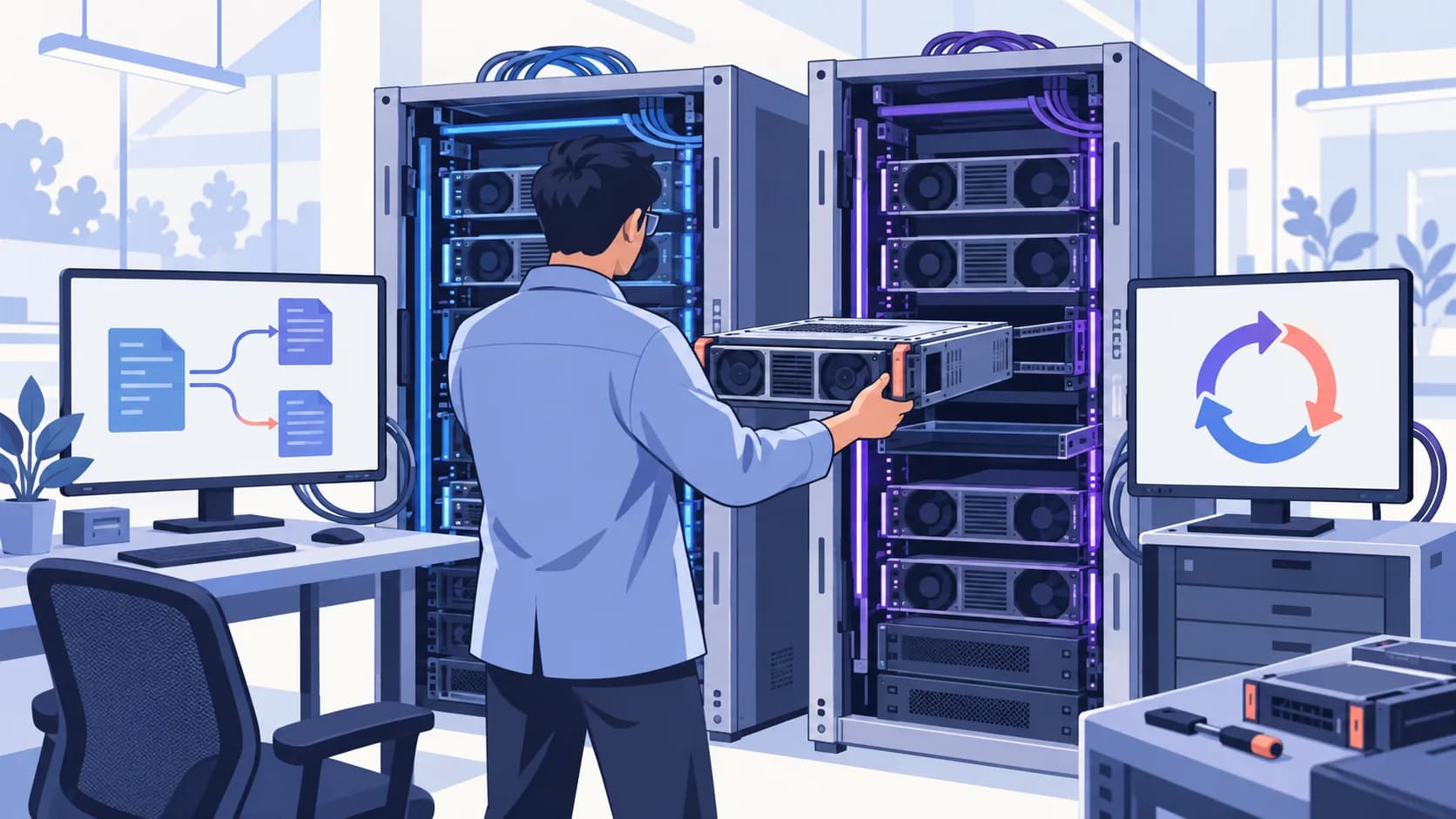
QwenGyre — a reinforcement-learning system for training AI agents, designed for multi-hour tasks. The Alibaba Qwen team’s work describes reallocating GPUs between task execution and model updates, as well as handling branching action histories. The authors report faster training compared with the selected baseline configurations. QwenGyre preprint.
For an AI project leader, the key question is: what evidence is needed to show that a training change improves the accepted outcome? Below is a breakdown of the announcement and a proposed log for discussing such a project with the team. This material is intended for technical leaders and process owners; it does not include deployment instructions or savings claims.
Prepared by AIrassvet from open sources, verified October 14, 2026. No in-house model training, QwenGyre testing, or independent result replication was performed. The illustration is conceptual; the practical schemes below are editorial suggestions, and the migration example is fictional.
Contents
- What’s new in the QwenGyre announcement
- Where the line is between training and a production service
- Three checks before ordering agent training
- Evidence log for a long-running task
- How to measure the benefit using a code migration example
- What limitations to keep in the solution
- QwenGyre FAQ
- How AIrassvet helps prepare a verifiable project
- Bottom line: prove accepted work first
What’s new in the QwenGyre announcement
Version v1 of the preprint was posted on arXiv September 27, 2026. The news discussion on October 12–13 is a separate news event, not the publication date of the research. The verified listing does not show confirmation of peer review. Research listing.
For Qwen 3.8 2.4T, the authors indicate roughly 700,000 tokens per run, 48 training steps, and an increase in NL2RepoBench from 52.5% to 58.5%. 6 percentage points. The maximum speedup in the configurations reviewed is 1.85x versus Colocate and 1.78x versus Async. The comparisons were made with the same GPU budgets; Claude Code 2.1.220 was used as the shell. Results and settings.
These figures cannot be used to calculate a Russian project budget. Such a calculation requires your own configuration, resource costs, team labor, and acceptable quality. There is no basis for carrying the speedup factor over into a commercial proposal or promising the same improvement in the company’s internal process.
Before discussing infrastructure procurement, it helps to define the decision that actually needs to be made. For example: continue monitoring the research, request a reproducible experiment from a contractor, or first fix the evaluation of the existing agent. Each decision requires its own data set; a news result does not make that choice for the leader.
Where the line is between training and a production service
Reinforcement learning uses outcome evaluation to change model behavior by updating its parameters. An agent in a production service performs a task with an already selected model. Therefore, reduced experiment time and reduced user response time should be checked separately.
It is useful to separate the roles of the software. verl/HybridFlow describes itself as a reinforcement-learning library for large language model training; SGLang — as an infrastructure for serving language and multimodal models. These projects provide context for different levels of the system, but their READMEs do not confirm QwenGyre’s results on your hardware. verl repository, SGLang repository.
A production service and an experiment that changes weights require separate access rules, resources, and evaluation. If the training loop has access to production accounts, a failed experiment may affect a real process. In the plan proposed here, tasks are run on data copies and in test environments; access to external actions is determined by the process owner.
It is also worth discussing compute movement between stages together with task preservation. Even if total training time decreases, you need to check whether the working directory was lost, whether an external request was repeated, and whether the artifact under review changed. These are proposed local verification criteria, not claims of defects in the research system.
There is also the question of availability. Based on the sources used, it is not possible to promise a ready-made commercial QwenGyre deployment, access from Russia, or a code-and-license package suitable for a specific company. Before the project starts, you need a separate list of available components with versions and usage terms; an arXiv article does not replace that.
Three checks before ordering agent training
First, check the repeatability of the task itself. If every assignment is fundamentally new and the result cannot be evaluated against predefined rules, the team risks optimizing a random set of examples. Start with a catalog of task types, input materials, and reasons for result rejection. The size of this catalog should match the diversity of the process, with no universal number of “enough examples”.
The second check is whether the artifact can be evaluated independently of how convincing the answer is. For code changes, you can define requirements for tests, compatibility, and checking dangerous operations. For a report, define rules for checking links and required calculations. For data migration, check completeness and integrity; a successful command does not by itself prove the migration was correct.
The third check concerns the current limitation. The agent may be making mistakes because of incomplete data, the wrong tool, or an unclear task. In that case, an expensive model update is premature: first, you should test fixing the source and the interface on the same set of examples. Another article covers training an agent from employee actions; recording actions and evaluating finished work solve different parts of the problem.
The next-step decision can be written briefly: “There is a repeatable process, a verifiable result, and a limitation that could not be removed with the available changes.” If even one point is not confirmed, a useful research outcome is refining the problem statement. That does not mean training will never be useful; it just means the basis for comparison has not yet been prepared.
Evidence log for a long-running task
Below is a proposed log format. It has not been validated on real training and is not an official QwenGyre standard. Its purpose is to make the experiment discussion auditable and to define in advance which records cannot be lost.
| Record | What to capture | What decision it supports |
|---|---|---|
| Task | Identifier, type, source data, and requirements | Are the compared attempts comparable |
| Versions | Model, shell, tools, evaluator | What exactly changed between variants |
| Completion | Success, failure, timeout, infrastructure outage | Can the result be used in comparison |
| Artifact | Saved result and verification report | Is there work that can be accepted |
| History | Calls, context changes, branches, repetitions | Is the link between the result and the actions preserved |
| Resources | Time, compute, external calls, manual rework | What is the full cost of the attempt |
It is especially important to distinguish verified failure from a lack of reliable verification. In the first case, there is an evaluation result with known rules. In the second, the evaluator did not respond, the data are corrupted, or the environment is lost. The log should use a separate status: uncertainty should not automatically be turned into a zero score for the model.
A retry also needs an explanation. It may have fixed a tool error, resumed work after a timeout, or carried out a new agent plan. If everything is recorded as identical attempts, it will be hard to identify the source of the changes. For this format, it is recommended to store the reason for the retry and a link to the original run.
It is better to plan the comparison before looking at successful results. You need shared tasks, a preselected verification method, and tracking of all started attempts. The stopping conditions and the rules for excluding corrupted records should be described separately. Otherwise, selecting only completed jobs can hide long hangs and manual rescues.
How to Evaluate the Benefit Using a Code Migration Example
Hypothetical example: a company wants to assign an agent to port small internal applications to a new library. Before discussing RL, the team gathers compatibility requirements and decides who approves changes. Some tasks are set aside for the final check; they are not used to tune the rules at each step.
The baseline version runs with the current model and environment. The candidate is tested on comparable tasks, while tests, artifacts, and stop reasons are preserved. Then the share of fully accepted changes, serious defects, and manual rework are compared. If both the model and the wrapper changed, the result belongs to the combination of components; the separate effect of training remains unidentified.
The proposed cost metric is all expenses of the compared variant divided by the number of fully accepted tasks. The numerator includes compute, external calls, reviewer work, and fixes. Training and data preparation costs should be allocated separately over a clearly specified usage horizon. If there are no accepted tasks, the metric has no finite value; such runs should be kept in the report.
The economic assessment depends on how many similar tasks actually arrive. A one-time expensive experiment may look different under a steady workload, but you cannot invent future demand to justify payback. A manager needs the observed process volume and a separate scenario for uncertain demand. The approach to handling long-running tasks complements the material on asynchronous AI agents.
What limitations should be left in the solution
The preprint notes the need for several switchable compute cells and the unexplored effectiveness under a significantly smaller total GPU budget. The authors also did not isolate the effect of sample order on training quality. The results remain sourced; there is no independent reproduction here. QwenGyre Limitations.
For a project decision, it is recommended to separately record the unknowns: availability of the required components, suitable hardware, reproducibility of the setup, quality of the local evaluator, and operating costs. A record of "not verified" is more useful than a numeric score without a basis. If an important model or software version changes, the previous comparison should be considered within the boundaries of the previous configuration.
Partial completion cannot be treated as a finished result just because it is convenient to evaluate during training. The user of the process may require a fully working artifact, even if the research evaluator distinguishes intermediate progress. Both criteria should be stored separately: the signal for updating the model and the acceptance rule for the work.
Frequently Asked Questions about QwenGyre
Does QwenGyre replace the chosen model?
Its role is to organize training around the model. For your own project, you need to define the model, environment, data, and evaluation separately; the training system announcement does not choose these components for the company.
Does faster training mean the same business savings?
No. A business calculation requires the full cost and the number of accepted tasks in your process. Data preparation, training, verification, and rework costs can change the outcome regardless of the compute time.
Can you start with a standard enterprise agent?
You can start by describing one process and logging the current solution's work. This makes it possible to test the setup and the success criteria. The decision to update the model is made after a separate comparison of options and resources.
What evidence should you ask the contractor for?
Request the component versions, comparable tasks, saved artifacts, evaluation rules, all stopped attempts, and the full cost calculation. Clarify which results were reproduced, which were borrowed from research, and which are still assumptions.
How AIrassvet Helps Prepare a Verifiable Project
For discussing training an enterprise agent, three areas are relevant at AIrassvet: process audit with acceptance criteria selection, data preparation with separation of control tasks, and integration design with the test environment. These align with the services listed on the website for LLM implementation and fine-tuning, data preparation, and testing. This is not a promise of support for QwenGyre or a repetition of its results. AIrassvet Areas of Work.
The first step is to describe one repeatable process, the current result, data sources, constraints, and who approves the work. After that, you can discuss which option to compare with the existing solution and what evidence to request before spending on training. Discuss the task.
Conclusion: First, proof of accepted work
QwenGyre gives a reason to check how long-running agent training is organized. For an enterprise project, a useful next step is to create a log of the task, versions, completion, artifact, and costs. It helps connect the experiment with a decision about a specific process.
Before promising savings, you need a comparable baseline solution and independent acceptance. If they are not prepared, start with those; if they are prepared, define the experiment conditions and the boundaries of the result. That way, the news becomes the basis for a verifiable project question.