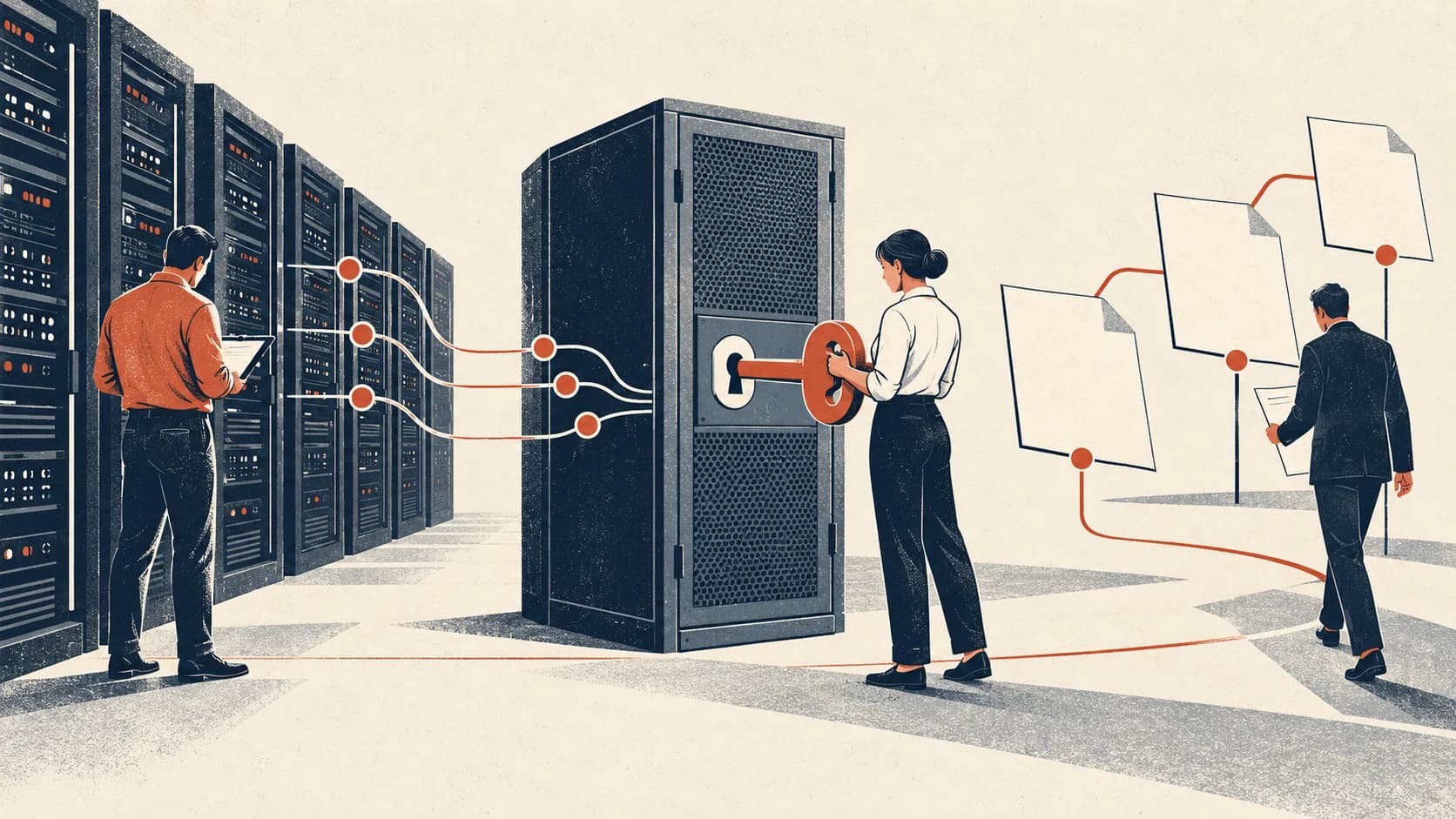
*Conceptual illustration of three layers: compute, data access rules, and business processes. Not a diagram of a joint product.*
Between October 20 and 26, 2026, several related announcements appeared for enterprise AI: llm-d reached version 1.0, Google opened TorchTPU, Oracle introduced Deep Trust AI Architecture, and ARIS listed October 26 as the availability date for Process Context for Enterprise AI. For businesses, this is a reason to separate three tasks: model serving, data governance rules, and agents’ understanding of business processes.
Key takeaways: These updates are useful for different teams. Developers building their own inference stack should look at llm-d and TorchTPU; Oracle system owners should review the data-layer changes; companies using ARIS should examine agent access to process models. These announcements do not justify urgently moving any AI bot to a new platform.
*Prepared by AIrassvet from original sources verified on October 26, 2026. This is a selective news briefing for IT and business leaders. We did not test the products, APIs, or claimed performance; use cases below are editorial scenarios. Pricing, availability for purchase in Russia, and compatibility with a specific deployment have not been confirmed.*
What made it into the digest
We selected published announcements with a specific product or architecture change, a primary source, and a clear internal audience. The Voxtral 3 voice release has already been covered separately, so we are not repeating it here. New model evaluations without a direct connection to a business task were also left out.
| Event | Date from the original source | What changed | Who should review it |
|---|---|---|---|
| llm-d 1.0 | October 20 | Advancement in distributed LLM serving | The team responsible for in-house model infrastructure |
| TorchTPU launch | October 20 | Native PyTorch stack for TPU released as open source | Developers with suitable compute resources |
| Oracle Deep Trust AI Architecture | October 26 | A multi-layer control architecture was introduced | Oracle data and application owners |
| ARIS Process Context for Enterprise AI | Announced on October 20; availability stated for October 26 | Process context for agents and applications | Process owners and the ARIS platform team |
Dates and wording were checked against messages from Google on llm-d, Google on TorchTPU, Oracle and ARIS. A claimed release does not mean the required configuration is already available in a specific customer account.
Contents:
- llm-d 1.0: model serving
- TorchTPU: choosing a compute platform
- Oracle: rules closer to the data
- ARIS: the agent needs process context
- What unites these announcements
- What conclusions are too early to draw
llm-d 1.0: model serving
What happened. Google announced the release of llm-d 1.0, an open-source distributed inference stack — in other words, a way to run model requests — built on Kubernetes. Claimed capabilities include cache-aware routing, priority management and fair load distribution across consumers, router fault tolerance, and stable v1 APIs. Google announcement.
IBM also ties the release to operations after initial deployment in its own statement: stable performance under different workloads and priority alignment. This confirms participation by the project’s developer, not an independent verification of the claimed performance. IBM statement.
Who benefits. Imagine a company where an employee assistant and overnight document processing share the same model pool. This is the suggested scenario: the point of priority management is to treat background jobs and user conversations as different workload classes. For that discussion, this news is more concrete than yet another generic LLM ranking.
Limitation. llm-d is part of the infrastructure for serving in-house models. For a small bot that only sends requests to an external API, deploying a separate Kubernetes stack may be unnecessary. The case for switching should be based on your own system design, not on the word “production” in an announcement.
Editorial takeaway: This release is worth studying for teams that already have a shared-load serving problem. It does not promise a universally cheaper response. The choice of where to host a model is covered separately in the article on LLM inference in Russian cloud infrastructure.
TorchTPU: choosing a compute platform
What happened. Google announced the open sourcing of TorchTPU, a native PyTorch stack for TPU. The post describes integrations with model training and serving tools, including vLLM, SGLang, Ray, and llm-d. The capabilities are at different stages; for example, the TPU agent suite is described as a preview version. Official TorchTPU post.
Who benefits. Developers who already work with PyTorch and are considering suitable TPU resources. The editorial point of the news is the expansion of compute platform options. Having an alternative is especially interesting when rethinking an architecture, but by itself it is not a reason to move a working project.
Limitation. An open software stack and available hardware are different things. Rental cost, quotas, the operator set for a specific model, and organizational access terms all require separate verification. In this digest, we are not comparing TPU and GPU on speed or price, and we are not testing code portability.
Editorial takeaway: Project owners should ask their team what exact problem the hardware change is meant to solve. If the answer is limited to the name of a new stack, the business case for migration has not yet been defined.
Oracle: rules closer to the data
What happened. Oracle introduced Deep Trust AI Architecture as an architectural framework for the software platform, data, access to data, and application development. The announcement describes access rules in Oracle AI Database, SQL Assertions for business constraints, and Deep Trust Data APIs for working with business objects instead of arbitrary table access. Oracle announcement from October 26.
Who benefits. Organizations that connect AI with enterprise data and already use the relevant Oracle stack. Consider a hypothetical example: an agent prepares an order but must not bypass the established approval limit. From the announcement, you can infer the direction of the architecture discussion — where the restriction should be enforced regardless of the wording of the model prompt.
Limitation. The architecture presented combines capabilities from several products. The announcement does not confirm their presence in every live version of the customer’s database, license, or deployment setup. Component availability and commercial terms must be checked separately; we did not run SQL examples or test the security mechanisms.
Editorial takeaway: This news is important above all as a reason to discuss where the rules are enforced. A vendor’s promise of a “trusted architecture” does not replace checking the specific path for reading and changing data in your own system.
ARIS: an Agent Needs Process Context
What happened. In its October 20 announcement, ARIS combined Object-Centric Process Mining, Process Lens, and MCP in the offering Process Context for Enterprise AI. Availability is listed as of October 26. Here, MCP is described as a way to give agents information about processes, roles, systems, rules, risks, and controls. ARIS source.
Who it’s useful for. Companies that already maintain their process model in ARIS. A hypothetical example is a procurement assistant: it is not enough for it to see a request card; to recommend the next step, it needs to understand the participants and the conditions for moving between stages. This illustrates the need for context, not a scenario for a new integration that we have verified.
Limitation. Connecting via MCP does not yet prove that the described process matches real-world operations. It also does not automatically define which actions the agent is allowed to perform. The process content, the current status of the rules, and the executor’s authority remain separate topics that must be examined.
The release includes research results, but we are not using them as a payback forecast for the reader. A public product announcement does not allow the same effect to be attributed to companies of different sizes and operating structures.
Editorial takeaway: for a process owner, the main change is another way to provide an agent with organizational context. The quality of that context cannot be achieved by the fact of connecting a tool alone.
What the announcements have in common
In our editorial reading, these events show vendors focusing on the system around the model. Google is discussing request servicing, Oracle — enforcing rules for data work, and ARIS — describing how a company’s operations are structured. These are different layers, so one solution does not replace the others.
For a manager, this means a practical distinction: slow response, an unauthorized action, and the wrong next step in a process may require different changes. Buying a new model is not a universal answer to all three problems. The specific cause must be identified in your own system; these announcements do not diagnose it.
What conclusions are still premature
Public demos should not be treated as proof of results on your own equipment or with your own data. This digest intentionally does not include a “who is faster” table or transfer advertising percentages onto the reader’s budget: we did not conduct a comparable independent test.
Russian availability, support terms, and implementation costs for the solutions reviewed are also not confirmed. For companies in Russia, this may change how relevant the news is even if there is technical interest. The analysis is useful for choosing a direction to investigate, not as a ready-made procurement conclusion.
How AIrassvet connects announcements to a business task
Within AI integration, LLM deployment, and data preparation projects, AIrassvet can help:
- identify which part of the workflow is limiting the result: model infrastructure, data, or the business process;
- prepare sources and access rules for a corporate assistant;
- design the agent’s connection to a business system and test the selected scenario.
You can start with one process: show the current workflow, data sources, constraints, and success criteria. This makes it possible to discuss the technology’s applicability without promising support for every product in the digest. Discuss the task.
Bottom line
The main reason to pay attention to the October 20–26 news is the development of infrastructure around AI agents. Choose the announcement that matches your task: llm-d and TorchTPU for model serving, Oracle for data-work rules, ARIS for process context. Then check applicability to your platform and project conditions; general news interest does not yet mean readiness for implementation.