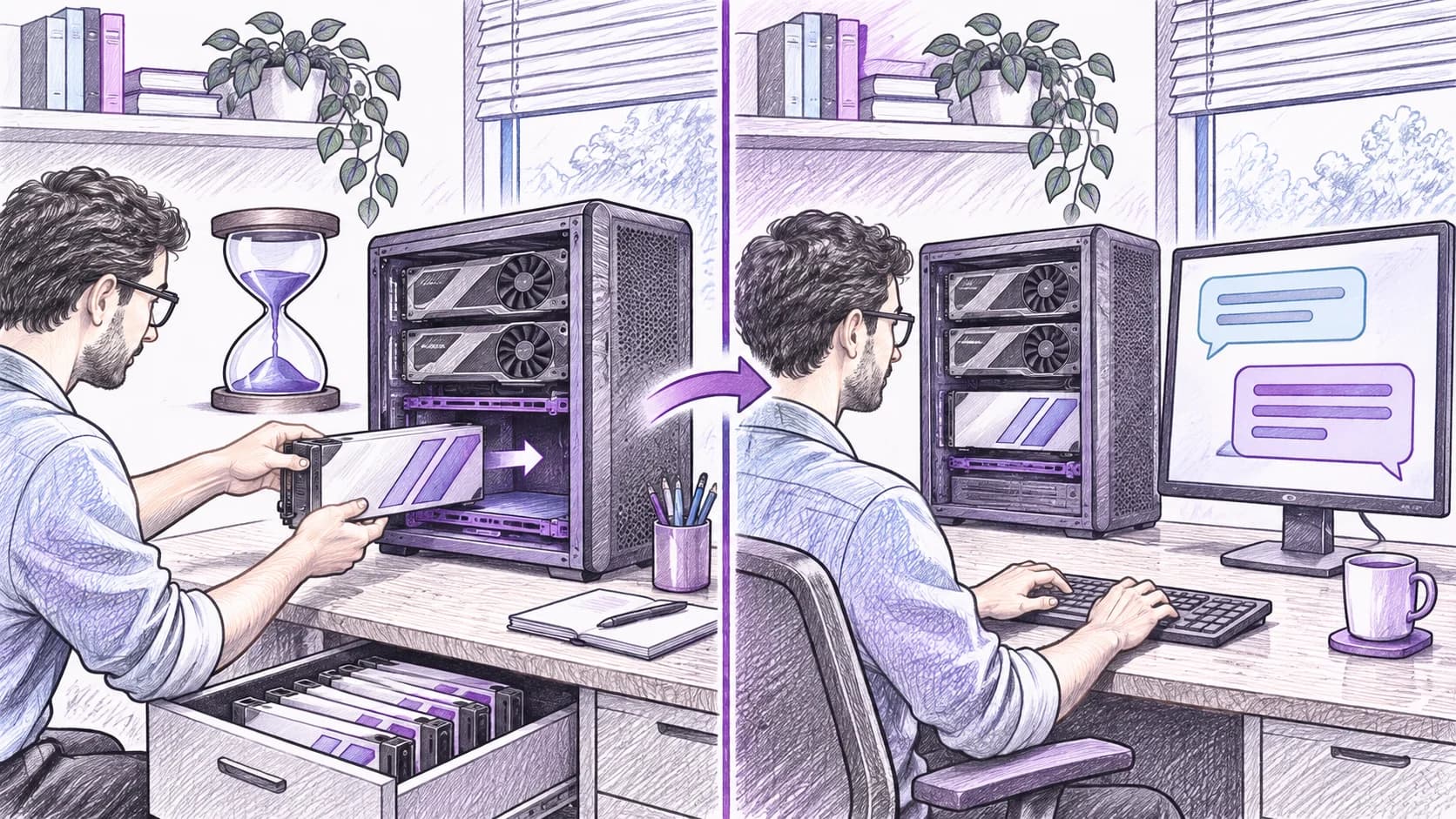
*Conceptual illustration of the scenario; not a product photo, client project, or completed test result.*
An AI streaming response can be displayed as it arrives, but it should only be saved as a finished result with the stream completion and the model’s stop reason in mind. In the Claude API, the end of a block, the end of a message, and the completion of a user task are different things. That determines whether an employee sees an interrupted response as a finished document and whether incomplete arguments make it into a tool.
This FAQ is for developers of enterprise chat interfaces and integration owners. We cover Claude’s Messages API and the Python SDK; details of other APIs may differ. Documentation checked on October 27, 2026. The states and examples described here are a proposed app design, not the result of a completed API test. We did not measure latency, cost, reconnect behavior, or the stop button.
The key difference: “The text is already visible” does not mean “the response is finished.” It helps for the app to store the current text, the request state, and
stop_reasonseparately, and pass only assembled and verified arguments to tools.
Contents
- What is streaming
- HTTP 200 and an error in the stream
- End of block and end of message
- The model stop reason
- Partial JSON
- Cancel and resume
- Saving to a business system
What is streaming?
Streaming is delivering a response in chunks within a single request. Claude Messages API uses Server-Sent Events, or SSE: the server sends events, and the client processes them as they arrive. The request includes stream: true. Streaming messages.
A fragment does not have to be a word, a sentence, or a separate business object. That is why the app should assemble content according to protocol rules instead of assuming that one network chunk equals one paragraph.
Proposed example: an assistant prepares a reply for a customer, and the employee sees the first lines before the last one. That is convenient for reading, but it still does not justify clicking “Send” automatically. In the interface, it helps to show the “Generating” state until both the technical and content processing are complete.
Streaming changes how the result is delivered. By itself, it does not improve text accuracy and does not guarantee that the full response will arrive faster.
Why doesn’t HTTP 200 guarantee a ready response?
The connection can open successfully, and the error can arrive later inside SSE. Anthropic explicitly warns that with streaming, an error can occur after HTTP 200. So checking only the initial HTTP status code is not enough. Claude API errors.
For the product, this means you need two different signals: the server accepted the request and the app actually received a completed result. If an error arrives after several fragments, the visible text should remain marked as interrupted, not turned into a normal assistant message.
A proposed diagnostic question for the team: “At which event do we change the response status from generating to ready?” The answer “after 200” shows exactly where to fix it. To investigate the issue, save the available request ID and the error description, without copying secret keys into diagnostic records.
You should also not treat every silent interval as an error. Streams can include service events. The decision to time out belongs to the app and network settings, not to the absence of new characters on the screen.
How does content_block_stop differ from message_stop?
The first ends a content block; the second ends the message. A single message can contain different blocks: for example, text and a tool call. Block data is tied to its indexes; stopping one block does not close the entire message. Claude event order.
Do not merge all incoming fragments into one string without accounting for type. What is meant for a tool field should not accidentally appear in the customer-facing response text. And vice versa: the assistant’s explanation does not become an action argument just because it arrived before it.
In the proposed interface, text and action status can be rendered separately. For example, an employee reads the explanation and, next to it, sees “Search parameters are being prepared.” This is a product behavior description; your team chooses the status names.
Why is message_stop not enough to mark something as “Done”?
The message ended, but the model may have stopped because of a limit or handed control to a tool. In Claude, the stop_reason field distinguishes, among other things, end_turn, max_tokens and tool_use. They cannot be interpreted as the same outcome. Handling stop reasons.
Suggested interpretation for the app:
| Observation | What it means for processing | How to show it to an employee |
|---|---|---|
| Text received, stream still open | The result is still being assembled | “Generating” |
Stream ended, end_turn |
The model finished its reply | “Response received,” then editorial review based on the task |
Stream ended, max_tokens |
The generation limit was reached | “The response may be incomplete” |
Stream ended, tool_use |
The tool call needs to be processed | "Prepared action," then separate processing |
| Error or interruption before completion | No complete result | "Interrupted," with the option to retry |
This is a table of proposed behavior, not built-in CRM statuses. Even end_turn does not prove that the model gave the correct answer to the user's question. It signals that the reply has ended; the quality and completeness of the business result are assessed separately.
Can an instrument be executed while JSON is still arriving?
Do not pass an unprocessed fragment as finished arguments. In fine-grained tool streaming, data can arrive without server-side buffering or JSON validation; the documentation warns about partial or invalid JSON, including when stopping at max_tokens. Fine-grained tool streaming.
Suggested fragment example:
{"customer_id":"C-17","comment":"DelivThis is an intentionally unfinished string for explanation. It is not a command that should be "filled in" and executed. A quote added by the application may make the JSON syntactically valid, but it will not restore the value the model intended to send.
For an action that writes to a business system, this order is useful: collect the block, parse the JSON, validate the schema and allowed values, then apply access and approval rules. If the arguments fail validation, the action should not start. This is a recommended integration pattern, not a guarantee provided by a single generation mode.
Intermediate parsing can be useful for previewing parameters. However, the ability to show a field in advance and the right to execute the operation are different decisions.
What should the "Stop" button do?
It should stop the real request, not just hide the incoming text. In the official Python SDK, exiting the context manager closes the stream; for early termination, stream.close()is also provided. The synchronous and asynchronous versions differ in how awaitis used. Streaming helpers Python SDK.
For your application, we recommend separating "the person no longer wants to read the answer" from "the computation has been stopped." If the front end stopped updating the screen but the server continues receiving data, that is not yet request cancellation.
Also, stopping generation does not cancel an already completed external operation. If the tool has already created a task, deleting or modifying it will require a separate action and the appropriate permissions. The stop button should not give the user a false impression of rollback.
Can an interrupted answer be continued from the same point?
Do not rely on a seamless continuation of the same transport stream. The Claude documentation describes recovery through a new request and separately distinguishes approaches for different model generations. In particular, for Claude 4.6 and later, it describes passing the partial response in a user message with a request to continue. Error recovery.
A new request should not be presented as a proven exact continuation of the original generation. The model may structure the text differently, repeat a sentence, or change the output. For a contract, report, or customer message, the result should still be treated as a draft.
For tool calls, it is even more dangerous to splice the old half of the arguments with a new one. It is preferable to retrieve the full object again and run normal validation. When repeating an external action, duplicate handling must be decided separately: repeating the model request is not automatic protection against creating the same record in CRM twice.
Can streaming be used but still return the full result?
Yes: the Python SDK provides get_final_message(), which waits for the stream to be read and returns the accumulated Message object. This is useful if the interface does not need incremental rendering and the integration needs the final object. Streaming helpers methods.
When choosing between incremental display and waiting for the full response, start with the task. In a chat, it can be useful for an employee to start reading sooner. To store a structured result in a database, it is easier to work with the assembled message. In both cases, you still need to handle errors and the reason for stopping.
The method for getting the final message does not verify the correctness of the business proposal, the accuracy of facts, or the user's right to change a record. Those are later processing stages in the application.
What should be saved in CRM or a database?
Save not only the text, but also its actual state. The suggested minimum set includes: the internal request ID, the accumulated content, a completion or interruption flag, the available stop_reason and the link to the subsequent tool operation. Your schema determines the field names.
For example, two visually similar texts may have different statuses. One is received in full and approved by an editor; the other is cut off after the first paragraph. If you store only the response string, the employee will not be able to tell the difference later.
For diagnostics, we recommend testing two scenarios in your own test environment: interrupt response reading and let generation end at a low token limit. In both cases, the incomplete draft should remain distinguishable from the accepted result. These checks were not performed as part of this article.
A general breakdown of the causes of agent process failures is provided in the article "How to Find the First AI Agent Error". Here, the task is narrower: not to lose the meaning of the state when passing the response from the API into the business system.
How AIrassvet helps bring the response into the business system
For this task, AIrassvet's work on integrating AI with business systems, testing, and preparing automated workflows is a good fit. In a specific project, you can define response states, set up delivery of the completed result, and connect the tool call to process rules. This is not a promise that network errors will never happen.
The first step is to choose one scenario: what the employee sees as generation progresses and what action is allowed after it. It helps to bring an example of an interrupted response and a description of where it is currently stored. Discuss the task.
What to do next
Check three independent decisions in your integration: when the stream ends, why the model stopped, and when the result is allowed to be used. Partial text can be shown as a draft; the finished message still needs to be interpreted by stop_reason; an external action requires assembled arguments and approval rules. This approach helps preserve the difference between "already visible" and "can be used."