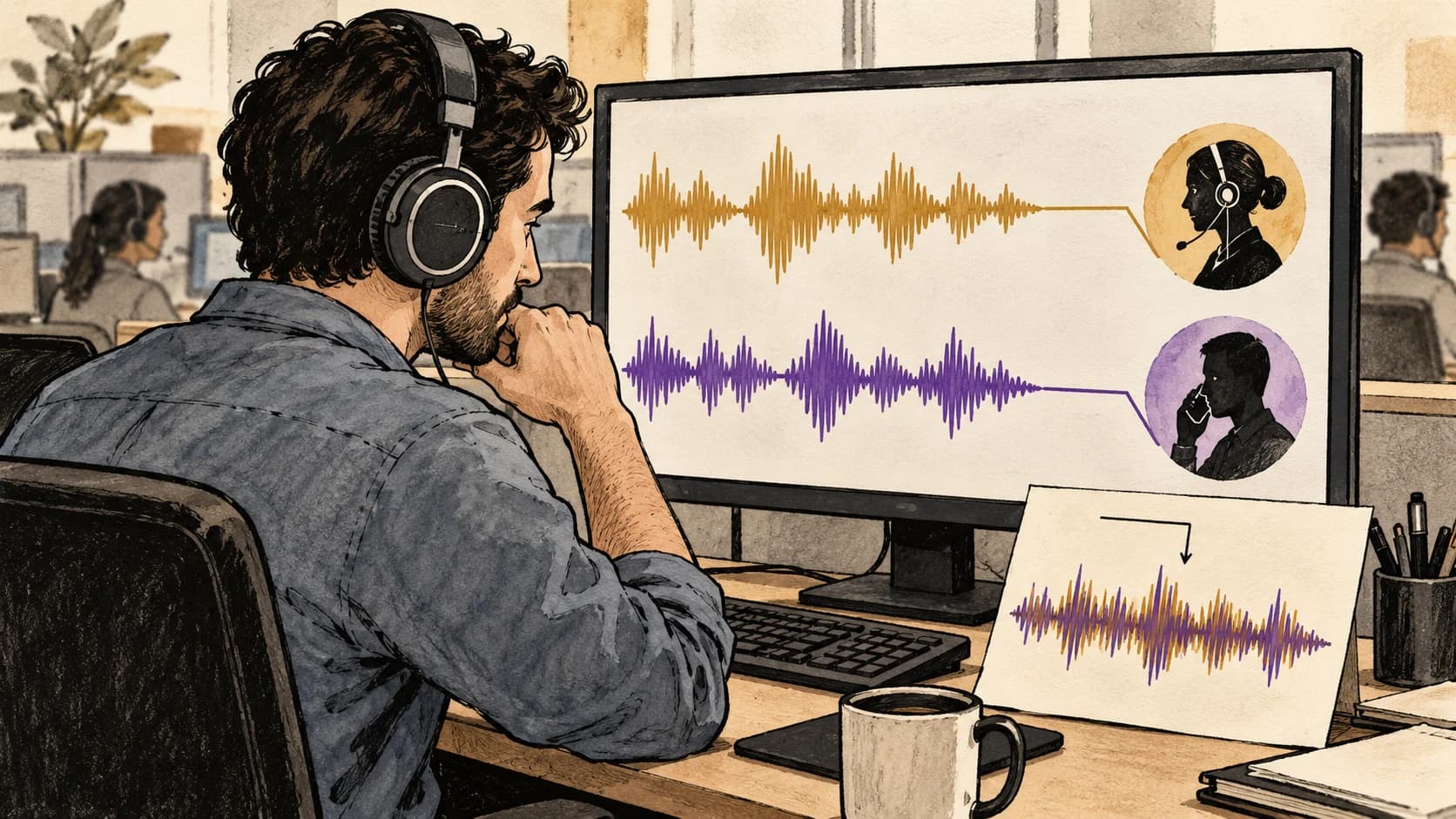
*Conceptual illustration of a scenario; not a product photo, client project, or completed test.*
If the call transcript mixes up the agent and the customer, first separate the three entities: the audio channel, the voice, and the business role. The channel is part of the recording, diarization groups speech by speaker, and the role links that group to a participant in the process. Replacing the recognition model will not fix the error if the application labels already correctly separated turns incorrectly.
This material is intended for speech analytics owners and telephony developers. We examine pre-recorded calls and documented capabilities of Yandex SpeechKit API v3. Documentation verified on October 27, 2026. For technical references, we used the available Russian-language documentation section for the Kazakhstan region; this is not a promise of identical endpoints, pricing, or availability in all regions. No SpeechKit requests, real-call listening, or quality measurements were performed here.
Short answer: if the voices are kept separate, use this information before mixing the recording. If only mono is available, consider speaker identification within the documented limitations. A group number does not automatically assign the person the role of “agent.”
Contents
- Why correctly recognized words get the wrong role
- What is in the source recording
- When to use channels
- When diarization is needed
- How to link a label to the agent
- Why turns are duplicated
- How to find the cause by symptoms
Why correctly recognized words get the wrong role
In the sentence “I’ll process the refund,” the words may be recognized correctly, but the label may be wrong. For an employee, this looks like an AI error overall. To fix it, you need to determine at which level it occurred: the audio was split incorrectly, the voice was assigned to a different group, or the correct group was linked to the wrong role.
Diarization answers the question “which segments belong to the same speaker.” Role labeling answers a different question: “who this speaker is in the service process.” By definition, a voice group does not contain the person’s job title or CRM ID.
Suggested example: in one call, the employee speaks first, and in another, the customer does. The rule “the first turn is always the agent” will produce an error in the second case even if the voices are separated perfectly. The cause is in the application rule, not in the word transcription.
That is why quality should be evaluated separately for the text and for turn ownership. We discuss the overall process architecture in the article on speech analytics for calls. Here we focus on a narrow issue: preserving the correct conversation participant.
What is in the source recording
The file extension does not tell you whether the voices are separated. In a stereo recording, the participants may be on separate channels, or it may be two copies of an already mixed conversation. In the second case, having two channels does not restore the lost separation.
For diagnosis, we recommend obtaining the original file before conversion, the telephony export description, and information about the number of channels. Then listen to each channel separately in an audio editor. This is a suggested order for checking your data, not an experiment we performed.
| What was found | What this means for choosing an approach |
|---|---|
| Each channel primarily contains its own participant | You can rely on the channel and the confirmed recording scheme |
| Both channels contain the same conversation | Work with mixed speech is needed; the formal stereo format does not help |
| Mono only, with two participants | Consider speaker identification for a compatible mode |
| A third participant appears in the conversation | The limitation of a specific feature becomes significant |
Do not destroy the source file when preparing files. Converting stereo to mono merges the channels; after that, you can no longer restore the original ownership by simply reading metadata. If the previous system stored the channel mapping separately, use that as well.
When to use channels
For pre-recorded multichannel files, SpeechKit provides an asynchronous mode. In the general documentation table, it lists two recognizable channels for this mode, while streaming mode supports one. SpeechKit recognition modes.
This determines the choice by task. If you are analyzing an already completed conversation with separate tracks, there is no need to turn it into an online dialog just because the SDK has a streaming example. You need to preserve the file properties and choose a compatible processing path.
A channel is useful as a technical foundation if you know that telephony records into it. But the statement “left is always the agent” must be confirmed by your system’s export format. The word “stereo” itself does not establish such an agreement.
Coding parameters are also important for delivering raw audio. The SpeechKit documentation describes LPCM as data without a WAV header and defines requirements for sample representation. Do not mistake a container WAV for raw LPCM just because it sounds similar during playback. Supported formats.
In API v3, the audio format description is separate from the recording content. Check the specific fields and types in the AsyncRecognizer reference, rather than carrying parameter names over from the older API v2 example.
When diarization is needed
In the dedicated SpeechKit documentation, speaker identification is described for API v3, the FULL_DATA mode, and mono recordings, with no more than two speakers. The example includes SPEAKER_LABELING_ENABLED; responses receive the labels channel_tag. Speaker identification.
This is an important applicability boundary. The mono feature is not a way to automatically get participant roles for any conference. If a customer, an agent, and an interpreter are on the line, that conversation already exceeds the documented limit on the number of speakers.
Also note the model in the official example: it uses general:rc. On the models page, rc is marked as a release candidate, not a universal name for all production requests. Recheck the current compatibility of the feature you need and the selected version. Models and version tags.
Do not combine every capability found in the documentation into one fictional mode. The existence of streaming recognition and separate speaker identification does not prove support for this combination in any configuration. For an already recorded file, choose the documented file-based scenario.
How to link a label to the agent
Do not hard-code the rule channel_tag = 0 → agent. In the speaker identification documentation, label values are described as 0 or 1, and fixed numbering is not directly guaranteed. The label helps separate the results; the role requires additional evidence. Label description in the response.
For separate channels, such a basis can be a verified telephony recording map: which leg and which participant are mapped to each channel. When a call is transferred, you need to check whether that mapping has changed. These are suggested integration questions, not a claim about how every PBX behaves.
For mono with diarization, a separate role-detection procedure is possible: based on the known call context, a verified greeting, or employee confirmation. A model’s confident phrase “this is the operator” by itself does not replace a factual basis. In an ambiguous case, it is better to leave “Speaker A” than to assign a promise to the wrong person.
Suggested internal record format, not an API response object:
{
  "speaker_group": "A",
  "business_role": "unknown",
  "role_basis": "not_confirmed",
  "text": "I’ll clarify the return conditions"
}
Separate fields make it possible to correct the role without rewriting the recognized text. They also make it possible to exclude uncertain statements from automated employee scoring until they are clarified.
Why the lines are duplicated
Sometimes the problem looks like “the customer and the operator said the same thing,” when in fact the app added the same phrase twice. In SpeechKit, there are intermediate partial, final final and normalized final final_refinement. When normalization is enabled, both final and final_refinement can arrive. Recognition result types.
If the handler treats each variant as a new line, the transcript grows with duplicates. This is different from a speaker-identification error. To fix it, you need to understand the result lifecycle and the chosen text update method, not change participant labels.
We suggest deciding at the application level in advance which result becomes the final displayed version and how it replaces the previous one. The key for linking events should be chosen based on the actual contract of the API you are using and your data; here we are not proposing an unverified universal formula for such a key.
How to find the cause from the symptoms
| Symptom | Likely source of the error | What to investigate first |
|---|---|---|
| All roles were mirrored | Channel or group-to-role mapping | The export scheme and mapping table |
| Individual short lines are getting mixed up | Mixed-speech separation or role rule | The original audio and the actual segment label |
| Both tracks contain both participants | Recording or early conversion | The source before channel merging |
| Each phrase appeared twice | Result event handling | Are final and refinement both being added independently? |
| After the call transfer, the labels became incorrect | Change in participant set | Telephony events and participant mapping |
These are diagnostic hypotheses, not established causes of a specific incident. To distinguish them, it helps to take one call approved for analysis, save the original audio, and look at the data before role assignment. If the speaker group is correct but the label is already wrong, the next processing layer should be fixed.
For the mono scenario, we suggest separately checking a change in the first speaker and the appearance of a third participant. For channels, use a controlled example where it is known who is recorded on each one. A successful check means you can explain where the label came from; it does not prove quality across the entire archive. The reader still needs to perform these checks.
Frequently asked questions
Do two channels guarantee two different voices?
No. Channels can contain the same mix. You need to verify the actual recording and the conditions under which it was obtained.
Does diarization identify the customer’s name?
In the function described here, it is about separating phrases by speaker. Name, account, and role are additional application data; the article does not cover biometric identification.
Will a different speech recognition model help?
It may change the text and speech segmentation, but it will not fix the incorrect rule “zero label means operator.” First find the layer where the error was introduced.
How AIrassvet helps preserve roles in speech analytics
AIrassvet’s work in multimodal integrations, data processing, and testing also applies to this process. The scope of work may include parsing the recording format, passing recognition results into analytics, and validating role assignment before use in a business system. This is not a promise of error-free participant identification.
The first step is to show one example recording available for analysis, the current transcript, and the point where the system assigns roles. Such a description makes it possible to separate an audio problem from an integration error. Discuss the project.
Conclusion
A correct line label requires a chain: the recording preserved the necessary distinctions, recognition returned the correct groups, and the application reasonably linked them to roles. For separate voices, use verified channels; for mono, account for speaker-identification limitations. If the role is still unknown, keep it unknown — that is more useful for analytics than a confidently incorrect label.