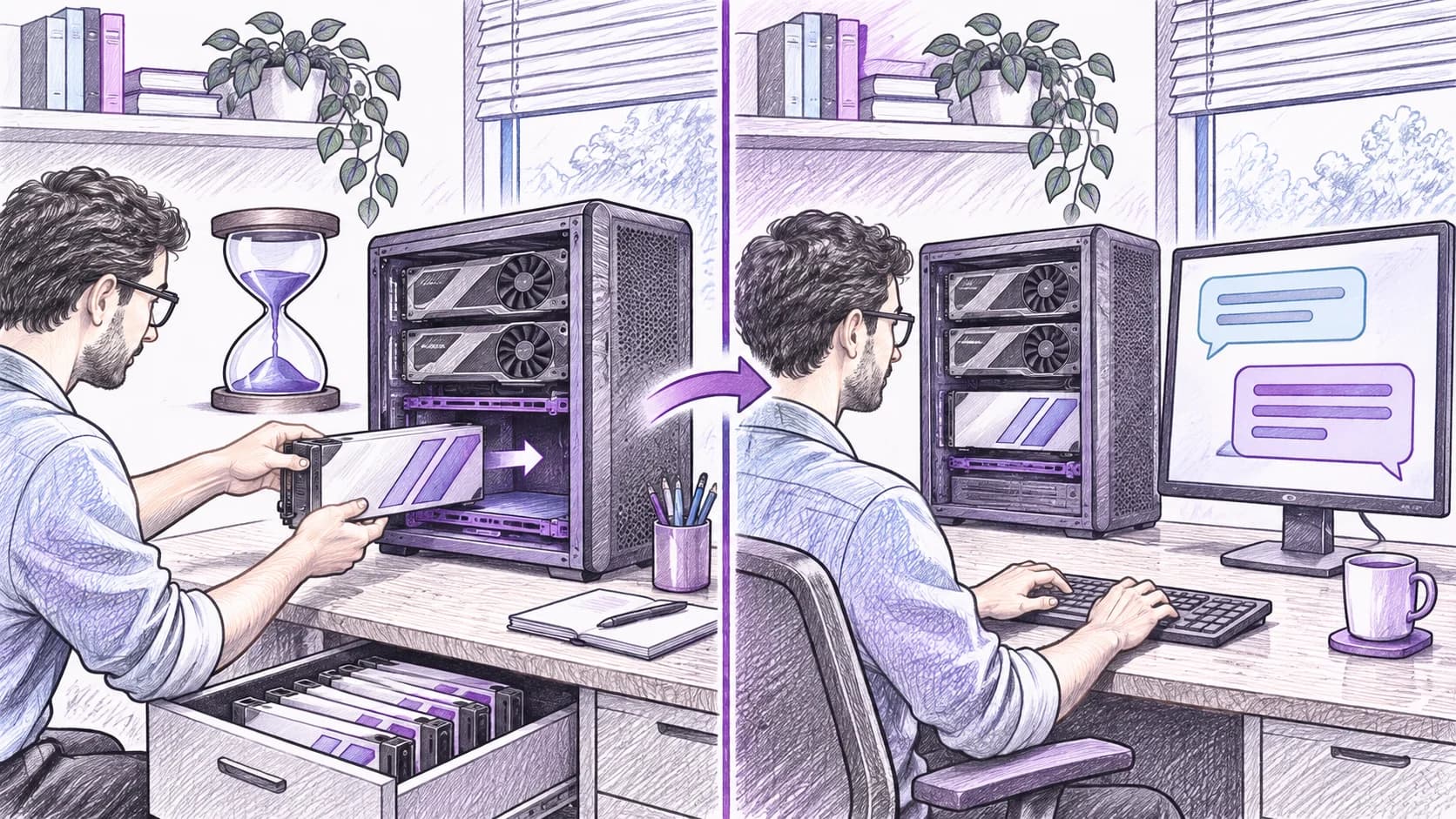
*Conceptual illustration of voice service and separate recording analysis. Does not depict Voxtral deployment or the call transfer to an operator feature.*
Mistral released Voxtral 3 on October 20, 2026: the new speech recognition and speech synthesis models were added to the voice agents SDK. For businesses, the key change is the ability to connect conversation, a language model, and tool calls in a single processing flow. However, SDK readiness for dialogue does not mean a specific phone line is ready to serve customers. Mistral announcement, model release dates.
This article was prepared by the AIrassvet editorial team on October 25, 2026 for support leaders and voice integration developers. It is an analysis of the release and its limitations based on the official documentation. We did not run Voxtral 3, make calls through the SDK, or measure Russian language quality. The hypothetical service example below explains the architecture; it does not describe a client project.
Key takeaway: the new stack is worth attention if you are building a voice app or upgrading from Voxtral 2. For a contact center, the decision depends primarily on telephony, available tools, and handling complex conversations.
In this article:
- What was released
- Tools and business systems
- Telephony limitations
- Speaker diarization and end of turn
- Migrating from Voxtral 2
- Speed and Russian
- Who can benefit from the release
What exactly Mistral released
Voxtral 3 is a family of speech processing components. It includes Mini and Small for file transcription, Mini Realtime for streaming speech recognition, and Mini TTS for text-to-speech. The Mistral registry lists October 20, 2026 as the release date for all four models and shows their status as Active. Lifecycle registry.
The SDK, or software development kit, combines audio capture, recognition, response generation, synthesis, and playback. The language model remains a separate layer that processes the conversation and calls tools. The documentation distinguishes between a saved agent with versioned configuration and a session, meaning one current conversation. This makes it possible to change agent settings separately and start a conversation with the required version. Voice Agents architecture.
For the development team, the point of the news is a reduction in the amount of custom glue logic needed. At the same time, company knowledge, tool permissions, and conversation-ending handling are still defined by the application. The release changes the set of available components; the business process still has to be built from them.
Why tools matter more than a pretty voice
Imagine a hypothetical support task: a customer asks where an order is, then requests a delivery reschedule. Delivering a natural-sounding answer is not enough. The agent needs to get the current status, find available dates, and perform the allowed change in the account system.
Voxtral distinguishes between two places where tools run. Server-side tools run on Mistral’s side: search, document libraries, and workspace connectors. Client-side tools call a handler in your application code. If you save such a function on the agent, its executable code is not stored there: the handler must be connected when the session starts. Tools documentation.
This leads to an architectural question: where will the action run during a real conversation? In a tutorial app, the function may work because local code is running. In another channel, that code may not be available. That is why moving a prototype between the browser, server, and telephony is a separate integration task.
For our hypothetical order, it makes sense to start by limiting the scenario to status lookup. Rescheduling delivery will require separately defining who is authorized to change the order and how the customer’s choice is confirmed. This is the editorial recommendation on scenario boundaries, not a built-in SDK guarantee. We covered the overall channel architecture in the article “Voice AI for a Call Center”.
Why the phone mode needs to be reviewed separately
In the announcement, Mistral describes phone scenarios broadly, including outbound calls. However, the current Telephony page sets narrower conditions: enterprise access through the Mistral team, inbound calls only, no transfer to a human agent. Connection setup is not a self-serve setting in the console. The company brings its own number and SIP system, and coordinates routing with Mistral. SIP here is the protocol for connecting the phone channel. Current Telephony documentation.
There is also a difference in tools: client-side handlers do not run in a phone call. Server-side tools are required for agent actions. So showing a working handler in an app does not prove that the same scenario is available to a caller. The limitations apply to the phone mode described by Mistral, not to every possible standalone integration. Phone channel limitations.
For businesses, the gap between the announcement and the technical page matters. If a process requires immediate handoff to a live agent or outbound dialing, that feature cannot be considered available based on the announcement alone. As of our review date, we rely on the more specific documentation limitations; Mistral does not explain the discrepancy in the pages we reviewed.
Two conversation tasks that still cannot be combined
Speaker diarization answers the question of which voice spoke a segment. End-of-turn detectionor turn detection, helps determine when the agent should respond. In Voxtral 3, these features are available in realtime, but one session cannot use them at the same time: combining diarize=true and turn_detection triggers an error. The documentation recommends using end-of-turn detection for live responses and analyzing the saved recording by speaker later. Current diarization rules.
This separation makes business sense: conversation and post-call analytics have different requirements. However, delayed transcription adds a separate processing step and requires deciding in advance whether audio is stored and where. Storage rights cannot be inferred from a technical example: the company defines its own workflow for real recordings.
The label speaker_1 is not an assigned customer identity either. It links segments of one voice within the transcript, but it does not carry identity across calls. The conceptual Mistral documentation also states that simultaneous speech from two participants is not supported in this version. Guidance on displaying overlapping segments should not be interpreted as a promise of high-quality interruption recognition. What speaker labels mean.
Therefore, the quality team needs to distinguish between the conversation text, the distribution of turns, and the confirmed roles of participants. These data points can be used together, but one does not prove the other. There is a separate article on building the analysis process itself on speech analytics for calls.
What changes in existing Voxtral 2 integrations
For the owner of a working integration, the news means API contract changes. In the migration guide, Mistral lists incompatibilities that affect client code and the transcription interface. Migrating from Voxtral 2.
| Change | Where it shows up | Product impact |
|---|---|---|
| Timestamps for individual words are no longer accepted | Request with timestamp_granularities=word |
Word-level highlighting and precise word-by-word editing cannot be preserved by simply switching models |
| Realtime settings are locked in after the first audio chunk | Late session.update |
Changing settings will require a new session |
| The family received new model identifiers | Application configuration | An explicit mapping is needed, separately for files, realtime, and synthesis |
For file transcription, segment-level markers are documented: start and end indicate time in seconds. This is a different level of detail than individual words. The diarize parameter requires these segment markers. File transcription.
This is not instructions for updating an app: we did not perform a migration or verify compatibility with the SDK installed in your environment. The practical takeaway already follows from the documentation: the subtitle system, recording editor, and voice agent may require different changes even if they previously used one Voxtral family.
How to read the speed and language support claims
In the announcement, Mistral claims a voice agent response time of under one second. That figure cannot be applied to your phone line: it is not our measurement and does not demonstrably account for your network, business system, or use case. Developer claim.
The documentation distinguishes between model latency and the latency from the end of the user's speech to the agent's audible response. The second includes end-of-utterance detection, language model processing, tools, synthesis, and playback. A short phrase like 'checking your order' may fill the pause, but it does not speed up the delivery of a useful result. That is why the latency of the spoken acknowledgment and the latency of the substantive answer should be evaluated separately. How Mistral defines latency.
Language coverage also depends on the component. The current documentation table lists 50 languages for file transcription, 45 languages and dialects for realtime, and 35 languages with more than 50 dialects for TTS. Russian appears in the table of available synthesis voices. This is information about support, not a verification result for Russian phone recordings. Languages by model.
Different numbers in the announcement and the documentation are not grounds to claim the same coverage across the entire stack. A decision on implementation requires a specific model combination. Account availability, payment, phone routing, and data processing for a company in Russia were not verified in this analysis.
Who the release is already useful for at the architecture level
For a voice web app team — as a way to connect recognition, response, and synthesis with less in-house infrastructure. What matters here is the ability to attach application handlers and manage agent configuration.
For a Voxtral 2 integration owner — as a reason to evaluate specific incompatibilities: timestamps, session settings, and model identifiers. The benefit of the new version is unknown in advance, but the need to check dependent functions is already confirmed by the documentation.
For a contact center with complex routing — as a candidate for a separate scenario that fits within the current limitations. A process that requires handoff to a live agent cannot be considered fully covered by the described phone mode. For an archive of recordings without live dialogue, it is enough to consider transcription separately; a full agent SDK may not be needed at all.
Methodology: the editors compared the announcement, the model registry, and Mistral's technical pages as of October 25, 2026. When the marketing description differed from the implementation limits, we showed the discrepancy and used the narrower documented contract. We did not recalculate the developer's benchmarks; we make no claims about leadership on Russian calls, cost savings, or production reliability.
How AIrassvet helps connect a voice scenario to a business process
AIrassvet works with AI agents and business system integration. For the task described, three areas are relevant: mapping the customer service journey, preparing data for responses, and connecting allowed actions to the corporate system. Specific support for Voxtral 3 and phone connectivity requires a separate technical check.
The first step is to choose one type of incoming request, name the response source, and define what result the customer should receive. For example, for a delivery question, separate status lookup from order changes. Discuss the task.
Conclusion
Voxtral 3 expands the set of components available for voice applications, and the new SDK combines them into a conversational stack. The most important part of the news for business is the boundaries of what can actually be implemented: phone mode, where tools run, the separation of diarization and end-of-utterance handling, and the incompatibilities when moving from Voxtral 2.
The next decision should be tied to one channel and one task. If the scenario fits within the documented limitations, there is a basis for a technical pilot. If it requires outbound calls, transfer to a live agent, or word-level timestamps, a verified way to close that specific gap is needed first.